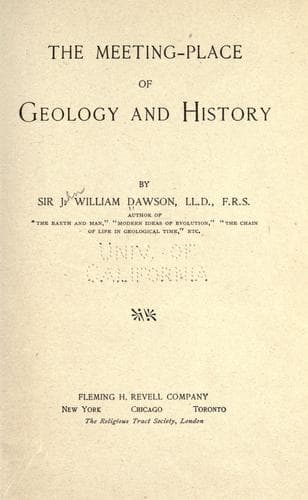
The Meeting-Place of Geology and HistoryDawson, John William, Sir
Religion
The Meeting-Place of Geology and History
Dawson, John William, Sir
Deluge; Prehistoric peoples
This remark, which I find made by other commentators as well, suggests,
it seems to me, somewhat different conclusions. The Hebrews when
settled, either in Egypt or in Canaan, were near to the sea-coast, and
familiar with boats and with the ships of the Phœnicians. If, therefore,
they persisted in calling Noah's ark a 'chest,' it must have been from
unwillingness to change an old history derived from their Chaldean or
Mesopotamian ancestors, or because they continued to regard the ark as
rather a great box than a ship properly so called. On the other hand, it
is likely that the particulars in the Chaldean account came from later
manipulation of the narrative, after commerce and navigation on the
Euphrates and Persian Gulf had become familiar to the Chaldeans. Thus in
this as in other respects the Hebrew narrative is the more primitive of
the two, and is consistent with the necessity of Divine instructions to
Noah, which, if he had been familiar with navigation, would not have
been necessary.[47]
[47] See also the evidence of an inland position of the writers in the
record of creation in Genesis i., as stated in my work cited in previous
note.
As in the Chaldean version, the Biblical history begins with the
specification of the ark. On this (Elohist) portion it is only necessary
to say that the dimensions of the ark are large and well adapted to
stowage rather than to speed, and that within it was strengthened by
three decks and by a number of bulkheads, or partitions, separating the
rooms or berths into which it was divided. Without, it was protected and
rendered tight by coats of resinous or asphaltic varnish (_copher_), and
it was built of the lightest and most durable kind of wood (gopher or
cypress). Only two openings are mentioned, a hatch or window above, and
a port or door in the side. There is no mention of any masts, rigging,
or other means of propulsion or steerage. The Chaldean history differs
in introducing a steersman, thus implying the means of propulsion as in
an actual ship.
Public-domain text, read in full here on John Shaqi.
Reviews
Reviews
No reviews yet
Be the first to share your thoughts on this work.
Elsewhere in the archive
Join the Discussion
Join the discussion
Sign in to leave a comment or review.
Sign InorCreate an account