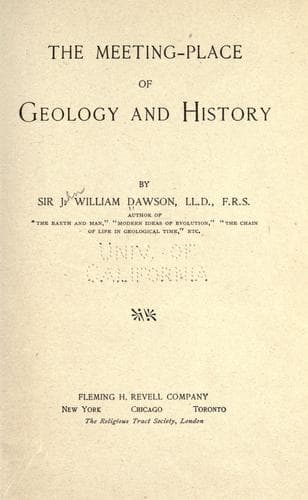
The Meeting-Place of Geology and HistoryDawson, John William, Sir
Religion
The Meeting-Place of Geology and History
Dawson, John William, Sir
Deluge; Prehistoric peoples
Noah is instructed, in addition to his own family, to provide for
animals, two of every kind; but these very general terms are afterwards
limited by the words _uph_, _bemah_, and _remesh_, which define birds,
cattle, and small quadrupeds as those specially intended. Noah's ark was
not a menagerie, but rather like a cattle-ship, capable perhaps of
accommodating as many animals as one of those steamers which now
transfer to England the animal produce of Western fields and prairies.
The animals portrayed on the ancient monuments of Egypt and Assyria,
however, inform us that, in early post-diluvial times, and therefore
probably also in the time of Noah, a greater variety of animals were
under the control of man than is the case in any one country at
present.[48] In the passage referring to the embarkation, only the
cattle and fowls are mentioned, but seven pairs are to be taken of the
clean species which could be used as food.[49] The embarkation having
been completed on the very day when the Deluge commenced, we have next
the narrative of the Flood itself. Here it is noteworthy that God
(Elohim) makes the arrangements, and Jahveh shuts the voyagers in.
[48] Houghton, _Natural History of the Ancients_, and _Transactions of
the Society of Biblical Archæology_; also representations of tame
antelopes, &c., on Egyptian monuments.
[49] This has been considered a later addition; but the practice of all
primitive peoples has sanctioned the distinction of clean and unclean
beasts, which is merely defined in the Mosaic law, not instituted for
the first time.
The first note that our witness enters in his 'log' relates to his
impressions of the causes of the catastrophe, which was not effected
supernaturally, but by natural causes. These are the 'breaking up of the
fountains of the great deep' and the 'opening of the windows of heaven.'
These expressions must be interpreted in accordance with the use of
similar terms in the account of creation in Genesis i., the more so that
this statement is a portion regarded by the composite theory as
Elohistic. On this principle of interpretation, the great deep is that
universal ocean which prevailed before the elevation of the dry land,
and the breaking up of its fountains is the removal of that restriction
placed upon it when its waters were gathered together into one place. In
other words, the meaning is the invasion of the land by the ocean. In
like manner, the windows of heaven, the cloudy reservoirs of the
atmospheric expanse, or possibly waterspouts, or even volcanic
eruptions, and not necessarily identical with the great rain extending
for forty days, as stated in the following clause. The Chaldean record
adds the phenomena of thunder and tempest, but omits the great deep; an
indication that it is an independent account, and by a less informed or
less intelligent narrator. It is worthy of note that our narrator has no
idea of any river inundation in the case.
Public-domain text, read in full here on John Shaqi.
Reviews
Reviews
No reviews yet
Be the first to share your thoughts on this work.
Elsewhere in the archive
Join the Discussion
Join the discussion
Sign in to leave a comment or review.
Sign InorCreate an account