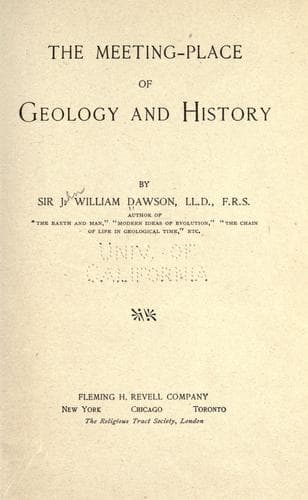
The Meeting-Place of Geology and HistoryDawson, John William, Sir
Religion
The Meeting-Place of Geology and History
Dawson, John William, Sir
Deluge; Prehistoric peoples
At this stage we are brought into the presence of the question: Is the
Deluge represented as a miraculous or a merely natural phenomenon? Yet,
from a scientific point of view, this question has not the significance
usually attributed to it. True miracles are not, and cannot be,
contraventions or violations of God's natural laws. They are merely
unusual operations of natural powers under their proper laws, but
employed by the Almighty for effecting spiritual ends. Thus, naturally,
they are under the laws of the material world, but, spiritually, they
belong to a higher sphere. In the present case, according to the
narrative in Genesis, the Flood was physically as much a natural
phenomenon as the earthquakes at Ischia, or the eruption of Krakatoa. It
was a miraculous or spiritual intervention only in so far as it was
related to the destruction of an ungodly race, and as it was announced
beforehand by a prophet. Had the approaching eruption of Krakatoa been
intended as a judgment on the wicked, and had it been revealed to anyone
who had taken pains to warn his countrymen and then to provide for his
own safety, this would have given to that eruption as much of a
miraculous character as the Bible attaches to the Deluge. In the New
Testament, where we have more definite information as to miracles, they
are usually called 'powers' and 'signs,' less prominence being given to
the mere wonder which is implied in the term 'miracle.' Under the aspect
of _powers_, they imply that the Creator can do many things beyond our
power and comprehension, just as in a lesser way a civilised man, from
his greater knowledge of natural laws and command over natural energies,
can do much that is incomprehensible to a savage; and in this direction
science teaches us that, given an omnipotent God, the field of miracle
is infinite. As _signs_, on the other hand, such displays of power
connect themselves with the moral and spiritual world, and become
teachers of higher truths and proofs of Divine interference. The true
position of miracles as signs is remarkably brought out in that argument
of Christ, in which He says, 'If ye believe not My words, believe Me for
the works' sake.' It is as if a civilised visitor to some barbarous
land, who had been describing to an incredulous audience the wonders of
his own country, were to exhibit to them a watch or a microscope, and
then to appeal to them that these were things just as mysterious and
incredible as those of which he had been speaking.
Public-domain text, read in full here on John Shaqi.
Reviews
Reviews
No reviews yet
Be the first to share your thoughts on this work.
Elsewhere in the archive
Join the Discussion
Join the discussion
Sign in to leave a comment or review.
Sign InorCreate an account