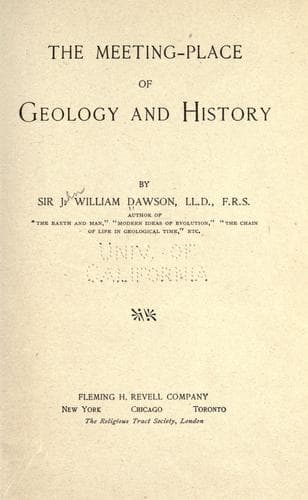
The Meeting-Place of Geology and HistoryDawson, John William, Sir
Religion
The Meeting-Place of Geology and History
Dawson, John William, Sir
Deluge; Prehistoric peoples
Our next may be that of an incandescent globe, molten and glowing, and
surrounded by a vast vaporous envelope, but tending by degrees to a
condition in which it shall have a solid crust, on which the greater
part of the watery vapour suspended in its atmosphere is to be condensed
into a heated ocean.
Our third picture may represent the world of what geologists call the
archæan, or eozoic period, when the crust had been furrowed up into
ridges of land, and corresponding but wider depressions occupied by the
sea. Into the latter the rains falling on the land are carrying sediment
derived from the wasting rocks, though the waters are still warm and the
thinner parts of the crust are still welling out rocky material, either
molten or dissolved in heated water. In this period there were probably
low forms of animal life in the waters and plants on the land, though we
know little of their exact nature.
A fourth picture may represent that great and long-continued palæozoic
period in which the waters swarmed with many forms of life, when fishes
were introduced into the sea, and when the land became covered with
dense forests of plants allied to the modern club-mosses, ferns,
mares'-tails and pines; while insects, scorpions and snails, and some
of the humbler forms of reptiles, found place on the land.
Returning after an interval, we should see a fifth picture, that of the
mesozoic world. This was the age of reptiles, when animals of that class
attained their highest and most gigantic forms, and occupied in the sea,
on the land, and in the air the places now held by the mammals and the
birds; while the continents were covered with a flora distinct alike
from that of the previous and succeeding periods, replaced, however, as
time went on by forests very like those of the modern world. In this age
the earliest mammals or ordinary quadrupeds were introduced, few at
first, small and of low rank in their class. Birds also made their
appearance, and toward the close of the period fishes of modern types
swarmed for the first time in the sea.
Lastly, we might see in the cenozoic, or tertiary age, the newest of
all, quadrupeds dominant on the land and modern types of animal life in
the sea. In this period our continents finally assumed their present
forms. Toward its close and after many vicissitudes of geography and
climate, and several successive dynasties of mammalian life, man and the
land animals now his contemporaries occupied the world, and thus the
cenozoic passes into the _anthropic_, or modern period, called by some,
but without good reason, 'quaternary,' since it is in all respects a
proper continuation of the tertiary, or cenozoic.[3]
[3] It will be seen that our six pictures are in some degree parallel
with the 'days' of creation. This is not an intentional reconciliation.
It merely expresses the fact of the case, whatever its significance.
Public-domain text, read in full here on John Shaqi.
Reviews
Reviews
No reviews yet
Be the first to share your thoughts on this work.
Join the Discussion
Join the discussion
Sign in to leave a comment or review.
Sign InorCreate an account