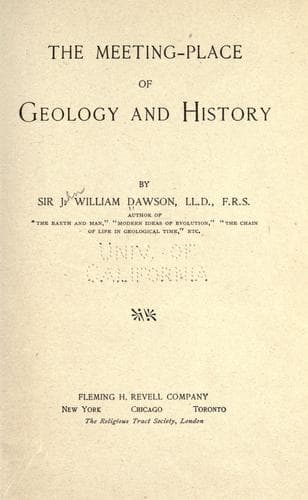
The Meeting-Place of Geology and HistoryDawson, John William, Sir
Religion
The Meeting-Place of Geology and History
Dawson, John William, Sir
Deluge; Prehistoric peoples
Before proceeding, I may refer by way of illustration to another
instance brought into very prominent relief by the publication of
Schuchardt's work on Schliemann's excavations. We all know how shadowy
and unreal to our youthful minds were the Homeric stories of the heroic
age of Greece, and our faith and certainty were not increased when we
read in the works of learned German critics that the Homeric poems were
composite productions of an age much later than that to which they were
supposed to belong, and that their events were rather myths than
history. How completely has all this been changed by the discoveries of
Schliemann and his followers! Now we can stand on the very threshold
over which Priam and Hector walked. We can see the jewels that may have
adorned Helen or Andromache. We can see double-handled cups like that of
old Nestor, and can recognise the inlaid work of the shield of Achilles,
and can walk in the halls of Agamemnon. Thus the old Homeric heroes
become real men, as those of our time, and we can understand their
political and commercial relations with other old peoples before quite
as shadowy. Recent discoveries in Egypt take us still farther back. We
now find that the 'Hanebu,' who invaded Egypt in the days of the Hebrew
patriarchs, were prehistoric Greeks, already civilised, and probably
possessing letters ages before the date of the Trojan War. So it is with
the Bible history, when we see the contemporary pictures of the Egyptian
slaves toiling at their bricks, or when we stand in the presence of the
mummy of Rameses II. and know that we look on the face of the Pharaoh
who enslaved the Hebrews, and from whose presence Moses fled.
Such discoveries give reality to history, and similar discoveries are
daily carrying us back to old events, and to nations of whom there was
no history whatever, and are making them like our daily friends and
companions. A notable case is that of the children of Heth, known to us
only incidentally by a few members of the nation who came in contact
with the early Hebrews. Suddenly we found that these people were the
great and formidable Kheta, or Khatti, who contended on equal terms with
the Egyptians and Assyrians for the empire of Western Asia; and when we
began to look for their remains, there appeared, one after another,
stone monuments, seals, and engraved objects, recording their form and
their greatness, till the tables have quite been turned, and there is
danger that we may attach too much importance to their agency in times
of which we have scarcely any written history. Thus, just as the quarry
and the mine reveal to us the fossil remains of animals and plants great
in their time, but long since passed away, so do the spade and pick of
the excavator constantly turn up for us the bones and the works of a
fossil and prehistoric humanity.
Public-domain text, read in full here on John Shaqi.
Reviews
Reviews
No reviews yet
Be the first to share your thoughts on this work.
Elsewhere in the archive
Join the Discussion
Join the discussion
Sign in to leave a comment or review.
Sign InorCreate an account