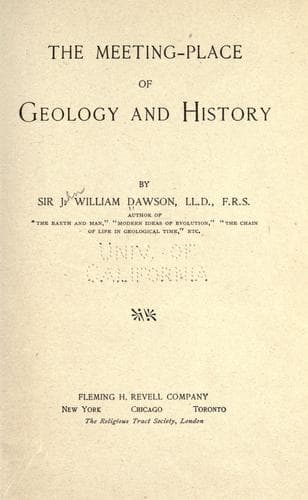
The Meeting-Place of Geology and HistoryDawson, John William, Sir
Religion
The Meeting-Place of Geology and History
Dawson, John William, Sir
Deluge; Prehistoric peoples
Egypt may be said to have no prehistoric period, and our task with it
will be limited to showing that its written history scarcely goes back
as far as many Egyptologists suppose and confidently affirm, and that
beyond this it has as yet afforded nothing. Egypt, in short, old though
it seems, is really a new country. When its priests, according to Plato,
taunted Solon with the newness of the Greeks and referred to the old
western empire of Atlantis, they were probably trading on traditions of
antediluvian times, which had no more relation to the actual history of
the Egyptian people than to that of the Greeks.
The limestones and sandstones which bound the Nile valley, sometimes
rising in precipitous cliffs from the bank of the stream, sometimes
receding for many miles beyond the edge of the green alluvial plain, are
rocks formed in cretaceous and early tertiary times under the sea, when
all Northern Africa and Western Asia were beneath the ocean. When raised
from the sea-bed to form land, they were variously bent and fractured,
and the Nile valley occupies a rift or fault, which, lying between the
hard ridges of the Arabian hills on the east and the more gentle
elevations of the Nubian desert on the west, afforded an outlet for the
waters of interior Africa and for the great floods which in the rainy
season pour down from the mountains of Abyssinia.
This outlet has been available and has been in process of erosion by
running water from a period long anterior to the advent of man, and with
this early pre-human history belonging to the miocene and pliocene
periods of geology we have no need to meddle, except to state that it
was closed by a great subsidence, that of the pleistocene or glacial
period, when the land of North Africa and Western Asia was depressed
several hundred feet, when Africa was separated from Asia, when the Nile
valley was an arm of the sea, and when sea-shells were deposited on the
rising grounds of Lower Egypt at a height of two hundred feet or
more.[64] Such raised beaches are found not only in the Nile valley but
on the shores of the Red Sea, and, as we shall see, along the coast of
Palestine; but, so far as known, no remains of man have been found in
connection with them. This great depression must, however, geologically
speaking, have been not much earlier than the advent of man, since in
many parts of the world we find human remains in deposits of the next
succeeding era.
[64] Hull, _Geology of Palestine and adjacent Districts_, Palestine
Exploration Fund. Dawson, _Modern Science in Bible Lands_, p. 311 and
Appendix. References will be found in these works to the labours of
Fraas, Schweinfurth, and others.
Public-domain text, read in full here on John Shaqi.
Reviews
Reviews
No reviews yet
Be the first to share your thoughts on this work.
Elsewhere in the archive
Join the Discussion
Join the discussion
Sign in to leave a comment or review.
Sign InorCreate an account