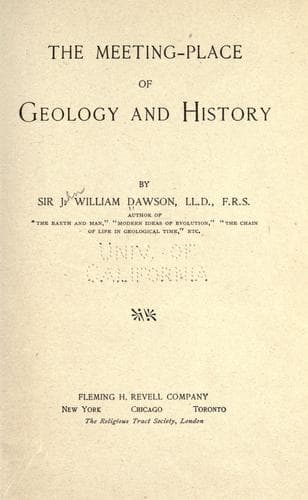
The Meeting-Place of Geology and HistoryDawson, John William, Sir
Religion
The Meeting-Place of Geology and History
Dawson, John William, Sir
Deluge; Prehistoric peoples
One of the kings of the eighteenth dynasty, whose historical position
was probably between the time of Joseph and that of Moses, Amunoph III.,
is believed to have married an Asiatic wife, and under her influence, he
and his successor, Amunoph IV., or Khu en-Aten, seem to have swerved
from the old polytheism of Egypt, and introduced a new worship, that of
Aten, a god visibly represented by the disk of the sun, and, therefore,
in some sense identical with Ra, the chief god of Egypt; but there was
something in this new worship offensive to the priests of Ra. Perhaps it
was regarded as a Semitic or Asiatic innovation, or led to the
introduction of unpopular Semitic priests and officers. Amunoph IV.
consequently abandoned the royal residence at Thebes, and established a
new capital at a place now called Tel-el-Amarna, almost at the boundary
of Upper and Lower Egypt, and from this place he ruled not only Egypt
but a vast region in Western Asia, which had been subjected to the
Egyptian government in the reign of the third Amunoph. From these
subject districts, extending from the frontiers of Egypt to Asia Minor
on the north, and to the Euphrates on the east, came great numbers of
despatches to the Pharaoh, and these were written not on papyrus or
skin, but on tablets of clay hardened by baking, and the writing was not
that of Egypt, but the arrow-head script of Chaldea, which seems at this
time to have been the current writing throughout Western Asia.[72]
[72] It is possible, however, that it may really have been a language of
diplomacy merely, and may have been used by the Semitic agents of
Amunoph as a cipher to communicate with the Egyptian court, and which
could not be read by messengers or enemies acquainted only with Hittite
or Egyptian hieroglyphics or with the Phœnician characters. For a
similar case see 2 Kings xviii. 26.
The scribes of the Egyptian king read these documents, answered them as
directed by their master, docketed them, and laid them up for reference;
and, strange to say, a few years ago, Arabs, digging in the old mounds,
brought them to light, and we have before us, translated into English, a
great number of letters, written from cities of Palestine and its
vicinity about a hundred years before the Exodus, and giving us
word-pictures of the politics and conflicts of the Canaanites and
Hittites and other peoples, long before Joshua came in contact with
them. Among other things in this correspondence, we find remarkable
confirmation of the sacred and political influence of Jerusalem, which
the Bible presents to us in the widely separated stories of Melchisedec,
king of Salem, in the time of Abraham, and of the suzerainty of
Adonizedec, king of Jerusalem, in the time of Joshua.
Public-domain text, read in full here on John Shaqi.
Reviews
Reviews
No reviews yet
Be the first to share your thoughts on this work.
Elsewhere in the archive
Join the Discussion
Join the discussion
Sign in to leave a comment or review.
Sign InorCreate an account