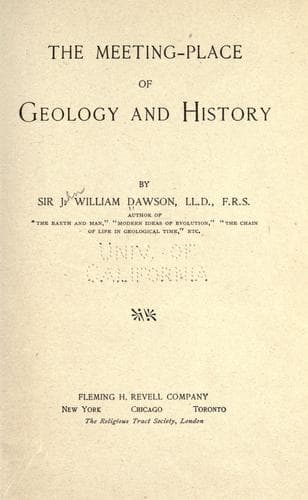
The Meeting-Place of Geology and HistoryDawson, John William, Sir
Religion
The Meeting-Place of Geology and History
Dawson, John William, Sir
Deluge; Prehistoric peoples
At the time in question, Jerusalem was ruled by a king or chief, subject
to Egypt, but, as in the times of Abraham and Joshua, exercising some
headship over neighbouring cities. He complains of certain hostile
peoples called _chabiri_, a name supposed by Zimmel[73] to be equivalent
to Ibrim or Hebrews, which to some may seem strange, as the Israelites
were, according to the generally received chronology, at this time in
Egypt. We must bear in mind, however, that according to the Bible the
Israelites were not the only 'children of Eber.' The Edomites, Moabites,
Ammonites, Ishmaelites, and Midianites were equally entitled to this
name; and we know, from the second chapter of Deuteronomy, that these
were warlike and intrusive peoples, who had, before the Exodus,
dispossessed several native tribes, so that we do not wonder at the fact
that a king of Jerusalem might have been suffering from their attacks
long before the Exodus.[74] It may be noted incidentally here, that this
wide application of the term Hebrew accords with the use of the name
_Aperiu_ for Semitic peoples other than Israelites in Egypt.
[73] Inaugural Lecture, Halle, 1891. Possibly these people were merely
'confederate' Hittites and Amorites (Sayce, _Records cf the Past_).
[74] I cannot agree with Conder that the Exodus took place as early as
the time of Amunoph III. The evidence we have from Egyptian sources
plainly indicates one of the immediate successors of Rameses II. as the
Pharaoh of the Exodus.
We have here also a note on an obscure passage in the life of Moses,
namely, his apparent want of acquaintance with the name Jehovah until
revealed to him at Horeb.[75] Now, as reported in Exodus, Moses in that
interview addressed God as 'Adon,' which is supposed to be the Hebrew
equivalent of 'Aten,' the meaning being Lord. This is a curious
incidental agreement with the prevalence of the Aten worship in Egypt,
and shows that this name may have been currently used by the Israelites,
whose God Moses himself calls Adon, till commanded to use the name
Jehovah.
[75] Exodus iii. 16 _et seqq._ This passage has been often
misunderstood, but it certainly shows that the name Jehovah had become
nearly obsolete among the Hebrews in Egypt, and that the name usually
given to God was Adon or Aten.
Public-domain text, read in full here on John Shaqi.
Reviews
Reviews
No reviews yet
Be the first to share your thoughts on this work.
Elsewhere in the archive
Join the Discussion
Join the discussion
Sign in to leave a comment or review.
Sign InorCreate an account