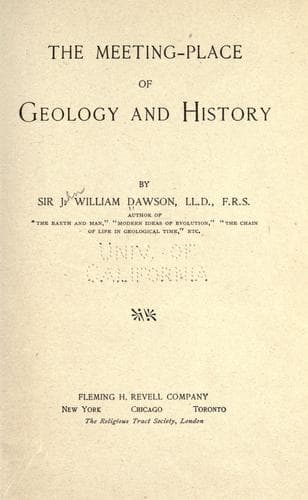
The Meeting-Place of Geology and HistoryDawson, John William, Sir
Religion
The Meeting-Place of Geology and History
Dawson, John William, Sir
Deluge; Prehistoric peoples
6. If we ask what our narrator supposed to be the original or Noachic
tongue, we might infer from his three lines of descent, and from the
locality of the dispersion and the episode of Nimrod's prehistoric
kingdom, that the primitive language of Chaldea would be the original
stem; and this we now know from authentic written records to have been
an agglutinate language of the type usually known as Turanian, and more
closely allied to the Tartar and Chinese tongues than to other kinds of
speech. It would follow that what we now call Semitic and Aryan or
Japhetic forms of speech must, in the view of our ancient authority,
date from the sequelæ of the great 'confusion of tongues.'
These points being premised, we can clear away the fogs which have been
gathered around this little luminous spot in the early history of the
world, and can trace at least the principal ethnic lines of radiation
from it. Though the writer gives us three main branches of affiliation
of the children of Noah, he really refers to six principal lines of
migration, three of them belonging to that multifarious progeny of Ham,
in which he seems to include both the Turanian and Negroid types of our
ordinary classifications, as well as some of the brown and yellow races.
One of the lines of affiliation of Ham leads eastward and is not traced;
but if the Cushite people, who are said to have gone to the land which
in earlier antediluvian times was that of 'gold and bedolach and shoham
stone,' that is, along the fertile valley of Susiana, were those
primitive people, preceding the Elamites of history, who are said to
have spoken an agglutinate language,[78] then we have at least one
stage of this migration. A second line leads west to the eastern coast
of the Mediterranean, to Egypt and to North Africa. A third passes
south-westward through Southern Arabia and across the Red Sea into
interior Africa. To the sons of Japhet are ascribed two lines of
migration, one through Asia Minor and the northern coasts of the
Mediterranean; another north-west, around the Black Sea. The Semites
would seem to have been a less wandering people at the first, but
subsequently to have encroached on and mingled with the Hamites,
and especially on that western line of migration leading to the
Mediterranean. All this can be gathered from undisputed national names
in the several lines of migration above sketched, without touching on
the more obscure and doubtful names or referring to tribes which
remained near the original centre. We must, however, inquire a little
more particularly into the movements bearing on Palestine and Egypt.
Public-domain text, read in full here on John Shaqi.
Reviews
Reviews
No reviews yet
Be the first to share your thoughts on this work.
Elsewhere in the archive
Join the Discussion
Join the discussion
Sign in to leave a comment or review.
Sign InorCreate an account