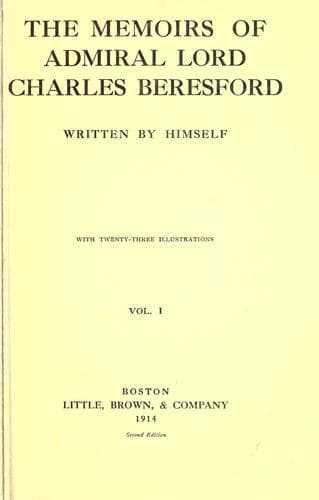
The Memoirs of Admiral Lord BeresfordBeresford, Charles William De la Poer Beresford, Baron
History
The Memoirs of Admiral Lord Beresford
Beresford, Charles William De la Poer Beresford, Baron
Admirals -- Great Britain -- Biography; Great Britain -- History, Naval -- 19th century
In the same year, the Prince of Wales, afterwards King Edward VII, went
to India, whither he was accompanied by Commander Lord Charles
Beresford, M.P., as A.D.C. (Lord Charles was promoted to the rank of
commander on 2nd {124} November, 1875.) The Prince received a telegram
informing him of the purchase of the Suez Canal shares when his ship
was passing through the Canal on the way to India. Lord Lytton was
appointed Viceroy of India. In 1876 it was announced that the Queen
was to assume the additional title of "Empress of India."
In July, 1875, there was trouble in the Near East, which, nearly two
years later, in April, 1877, resulted in the declaration by Russia of
war against Turkey. The Mediterranean Fleet was ordered to pass the
Dardanelles. In March, 1878, Lord Derby resigned, and Lord Salisbury
succeeded him at the Foreign Office. Mr. Gathorne Hardy went to the
India Office, Colonel Stanley to the War Office, and Mr. James Lowther
became Chief Secretary for Ireland. Sir Michael Hicks-Beach had
already succeeded Lord Carnarvon at the Colonial Office.
In the Parliament of 1875-80, young Mr. Parnell began his career.
Indomitable, subtle, cold and inscrutable, he speedily became a power.
A Protestant in faith, he had his foot on the necks of the Irish Roman
Catholic Nationalist members; half an Englishman by birth, he was an
implacable enemy of England. Utilising the tactics of obstruction, he
succeeded in bringing discredit upon a Government which was powerless
to control him and his led captains. He forced the Government to pass
a Bill for University Education in Ireland; and as the measure was no
better, if no worse, than the Gladstonian scheme which had been
rejected, so the result upon the Conservative administration was
equally injurious.
Mr. Gladstone emerged from his studies in Papal infallibility to
denounce Bulgarian atrocities and the like. But the country declined
to become excited on the subject. In the meantime the Russian army was
approaching Constantinople. The British Government took public
measures of military and naval precaution clearly implying that Russia
would not be permitted to occupy Constantinople. Prince Bismarck
thereupon intervened, and invited the nations concerned to discuss
matters at Berlin. Lord Beaconsfield (he {125} had received his
peerage in 1876) and Prince Bismarck were the two most powerful men in
Europe. Beaconsfield chose himself to represent Great Britain at the
Congress, which opened at Berlin on 13th June, 1878. Lord Beaconsfield
returned in triumph, bearing with him "Peace with Honour."
Public-domain text, read in full here on John Shaqi.
Reviews
Reviews
No reviews yet
Be the first to share your thoughts on this work.
Elsewhere in the archive
Join the Discussion
Join the discussion
Sign in to leave a comment or review.
Sign InorCreate an account