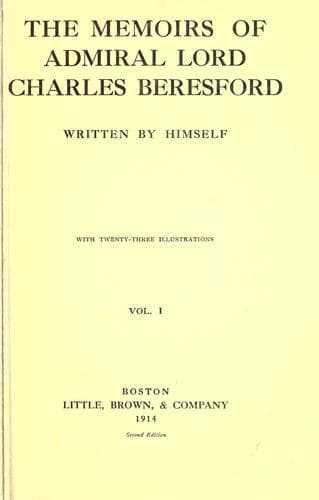
The Memoirs of Admiral Lord BeresfordBeresford, Charles William De la Poer Beresford, Baron
History
The Memoirs of Admiral Lord Beresford
Beresford, Charles William De la Poer Beresford, Baron
Admirals -- Great Britain -- Biography; Great Britain -- History, Naval -- 19th century
The advance of Russian influence in Afghanistan induced the British
Government, in 1878, to dispatch an expedition to Cabul, which was
occupied by British troops, and from which the Amir, Shere Ali, fled.
Followed, the signature of the treaty of Gandamak by Yakoob Khan, son
and successor of Shere Ali; the treacherous murder of Sir Louis
Cavagnan, British Envoy, and the greater number of his staff; and the
recapture of Cabul by British troops. The true history of the whole
affair, much distorted at the time (and since) by political malice, is
lucidly set forth in Lord Roberts's _Forty-one Years in India_, by the
great soldier who took so distinguished a part in it.
Another frontier war broke out in 1879. In South Africa, Sir
Theophilus Shepstone had annexed the Transvaal; Sir Bartle Frere, Lord
High Commissioner, announcing to the Zulu king Cetewayo, that Cetewayo
was entitled to a strip of territory claimed both by Cetewayo and the
Transvaal Republic, ordered him to disband his army. The advance of
British troops was checked by their total defeat by the Zulus on 22nd
January, 1879, at Isandhlwana. Lord Chelmsford the commander-in-chief,
prosecuted the campaign, defeated Cetewayo and took him prisoner.
During the war the young Prince Louis Napoleon, son of the Empress
Eugenie, lost his life.
In the meantime, the trade of the country had been profoundly
depressed, with the natural result that there was much discontent. On
24th March, 1880, Parliament was dissolved; and the Liberal party were
returned with a majority of some hundred and twenty. The Queen sent
for Lord Hartington; sent for Lord Granville; and finally, for Mr.
Gladstone.
{126}
The Russo-Turkish war of 1877 had brought Russia into opposition to
Austria-Hungary, thus destroying the alliance of the three Emperors;
and although Bismarck made peace between the two Powers at the Congress
of Berlin, Russia became estranged from Germany. In order to restore
her security, Germany concluded an alliance with Austria-Hungary and
shortly afterwards with Italy, which had quarrelled with France
concerning her occupation of Tunis. Thus was formed the Triple
Alliance. Its counterpoise was the drawing together of France and
Russia, in view of whose possibilities Prince Bismarck in 1887
increased the German Army. In 1900 Germany passed the Navy Law, which
ordained that the German Fleet should be so strong that any attack upon
it would be dangerous to the attacking party.
Nothing but the strength of the British Fleet, which had been largely
increased by the action of Lord Charles Beresford in 1888, and again by
the naval programme of 1893, and whose organisation had been brought to
a high state of efficiency by Admiral Sir Frederick Richards
(afterwards admiral of the Fleet), prevented the outbreak of war
between England and France at the time of the Fashoda incident in 1897.
Public-domain text, read in full here on John Shaqi.
Reviews
Reviews
No reviews yet
Be the first to share your thoughts on this work.
Elsewhere in the archive
Join the Discussion
Join the discussion
Sign in to leave a comment or review.
Sign InorCreate an account