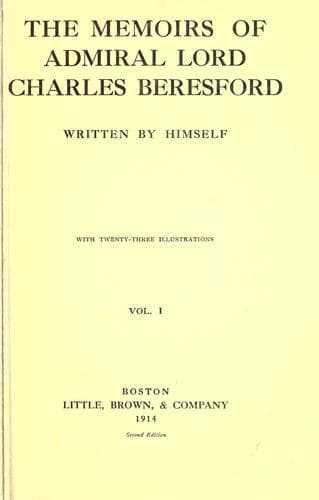
The Memoirs of Admiral Lord BeresfordBeresford, Charles William De la Poer Beresford, Baron
History
The Memoirs of Admiral Lord Beresford
Beresford, Charles William De la Poer Beresford, Baron
Admirals -- Great Britain -- Biography; Great Britain -- History, Naval -- 19th century
The nature of the problem of the land in Ireland may be exemplified
from my own experience as a landlord. I came into my property in 1866,
and when I returned from the sea two years later, being in need of
money, I wrote to my agent, telling him that I intended to inspect the
estate. He replied asking me to come as soon as I could, and adding
that I should be able to raise the rents all round. I told him to do
nothing until my arrival. When I went over, I drove to one of my farms
upon which it was proposed to raise the rent. The farm was about 48
acres in extent, situated in the middle of a bog. Here I was
entertained by one of the finest old Irishmen I have ever seen, and his
three sons. Said I to him:
"I want to talk to you about the rent. I hear that you are paying me
only 2s. 6d. an acre, whereas I can get 18s. an acre in the market."
I shall never forget how the poor old man's face fell as he said:
"For the love of God, do not turn me out, Lord Charles, I will give you
12s. an acre sooner than you should turn me out."
And then he told me that he had occupied the farm during 48 years; and
in that time he and his sons had raised the original value to 18s. an
acre. Of course I told him to stay where he was at the old rent. But
by the law of the land I could have turned him out and put in a new
tenant who would have paid me 18s. an acre, the increased value being
solely due to the exertions of the old man and his sons. Had I been an
absentee landlord, it would have been an ordinary matter of business to
have instructed my agent to turn the man out and to raise the rent; and
that very course was taken in thousands of cases. There was no
compensation for tenants' improvements before 1870; and a farmer who
did his best for the land, and to whose exertions alone increased value
was due, must pay the increased rent or go.
The monstrous land system in Ireland naturally caused {130} the tenants
to feel distrust and enmity towards the landlords; for, although not
many landlords abused their powers, the knowledge that they _could_
abuse them was alone sufficient to create suspicion and hostility.
Again, the great companies which bought land on speculation, exacted
rents at the outside market value. A company cannot be expected to
make allowances. Nor did the companies know the tenants or care for
them. But under the Irish custom they were the tenants who had
themselves by their improvements raised the value of the land.
In fairness to the landlords, it should be understood that the tenants
objected to the improvement of property by the landlord. "If you, the
landlord," the tenant argued, "improve the land, you will be raising
the rent on me. I would rather make my own improvements."
Public-domain text, read in full here on John Shaqi.
Reviews
Reviews
No reviews yet
Be the first to share your thoughts on this work.
Elsewhere in the archive
Join the Discussion
Join the discussion
Sign in to leave a comment or review.
Sign InorCreate an account