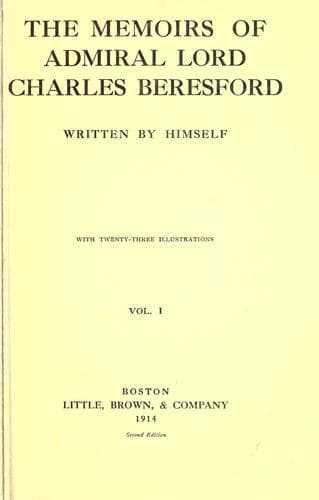
The Memoirs of Admiral Lord BeresfordBeresford, Charles William De la Poer Beresford, Baron
History
The Memoirs of Admiral Lord Beresford
Beresford, Charles William De la Poer Beresford, Baron
Admirals -- Great Britain -- Biography; Great Britain -- History, Naval -- 19th century
The affair caused both nations to reconsider the situation; with the
result that they settled all outstanding difficulties; and the Triple
Entente of Great Britain, France and Russia balanced the Triple
Alliance. Germany, in 1912, added some 70,000 men to her army, while
Austria and Italy increased their fleets. By the time the Allied
nations of the Near East had declared war upon the Turkish Empire, in
1912, Russia had recovered from the disastrous results of her war with
Japan, so that the Triple Entente once more balanced the Triple
Alliance. But the war in the Near East, with the heavy losses it
inflicted upon Turkey, had opened anew the whole Eastern question. The
settlement concluded {127} at the Berlin Conference thirty-four years
previously was abolished in a moment.
It has been thought worth while to trace the main developments of
European politics from 1873 to the present time; as it happened to Lord
Charles Beresford to be a member of that Parliament which saw the
triumph of the Beaconsfield policy in foreign affairs, and to be a
member of subsequent Parliaments confronted with the emergence of new
and sinister international conditions.
{128}
CHAPTER XV
AN IRISH ELECTION AND IRISH POLITICS
The political situation in Ireland at the time when I entered politics
was characteristically exemplified in the Kerry election of 1872, in
which I took part. It was fought entirely on the Home Rule issue,
which had been revived by Isaac Butt when, in 1870, he formed his Home
Government Association.
In the Kerry election of 1872, the Roman Catholic hierarchy was opposed
to Home Rule. The anti-Home Rule candidate, Mr. Deas, was a Roman
Catholic, a local landlord and extremely popular. His opponent, Mr.
Blennerhasset, was a Protestant and a stranger to the locality. But
because he was a Home Ruler, he was elected in spite of the priests and
of the personal claims of Mr. Deas, winning by 839 votes. I may add
that he won in spite also of my exertions, which were considerable. I
started at two o'clock in the morning with Mr. Harry Herbert of
Muckross, and led a band of 350 tenants to the poll. (The Ballot Act
was not passed until 18th July of the same year, 1872.)
Having polled the tenants, I was strolling in the street, when I was
stopped by one of my grand fellow-countrymen, a huge man of about six
feet five.
"Are ye for Home Rule?" says he.
"To hell with your Home Rule!" said I. Whereupon he hit me on the
point of the nose, knocking me over backwards, and effectually
silencing my arguments for the space of an hour and a half.
{129}
Public-domain text, read in full here on John Shaqi.
Reviews
Reviews
No reviews yet
Be the first to share your thoughts on this work.
Elsewhere in the archive
Join the Discussion
Join the discussion
Sign in to leave a comment or review.
Sign InorCreate an account