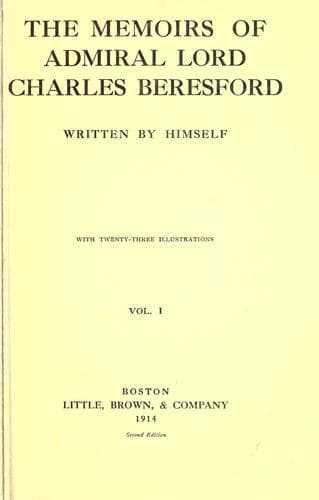
The Memoirs of Admiral Lord BeresfordBeresford, Charles William De la Poer Beresford, Baron
History
The Memoirs of Admiral Lord Beresford
Beresford, Charles William De la Poer Beresford, Baron
Admirals -- Great Britain -- Biography; Great Britain -- History, Naval -- 19th century
I have always preferred a hostile political meeting to a peaceable
assembly; nor have I ever failed to hold a hostile audience except upon
one occasion, during the York election. I had sent a speaker to occupy
the attention of an audience, largely composed of my own countrymen,
till I came, and by the time I arrived he had succeeded in irritating
them beyond the power of pacification.
But one can hardly save oneself from one's friends. During the
Waterford election I came one evening to Youghal and went to the hotel.
I was peacefully smoking outside the inn, when a party of the boys came
along, hooting me, and presently they began to throw stones. When I
advanced upon them they ran away and were lost in the darkness. As I
turned to go back to the hotel, a large missile caught me behind the
ear, knocking me over.
Next morning I related the incident to one of my most enthusiastic
supporters in the place.
"'Tis a disgrace," said I, "throwing stones in the dark. And as for
that boy who made a good shot, if I could get hold of him I would
scatter his features."
"Ye would not," said he.
"And why wouldn't I?" said I.
"Because," says he, "it was myself that threw that brick. An' didn't I
get ye grand!" says he. "But ye're not hurted. Sure ye're not hurted,
or I wudn't have told ye annything about it."
It wasn't disloyalty on his part. It was simply that he couldn't
resist what he considered a joke.
The result of the polling was: Beresford, 1767; Esmonde, 1390;
Longbottom, 446.
A salient characteristic of the Irish race is that they will not endure
condescension towards them. They admire resolution and determination,
and will submit to the sternest discipline if it is enforced upon them
by a man who understands {137} them and whom they respect. Conversely,
they will yield nothing to weakness, and will return any assumption of
superiority with hatred and contempt. Hence it is that the English
have so often failed in their dealings with the Irish. In spite of the
violence the Irish often exhibit in politics, their pride of race and
pride in one another remain their notable characteristics.
I recently overheard a remark which illustrates the Irish master
sentiment. During the debates upon the Home Rule Bill which took place
in the House of Commons in 1912, one of his Majesty's Ministers, having
made a long and an eloquent speech in support of that measure,
punctuated by enthusiastic cheers by the Nationalist members, had it
knocked to smithereens by Sir Edward Carson. Afterwards, I heard one
Nationalist member say to another, "Wasn't that grand, now, to see the
Irishman knocking spots out of the Saxon!" Yet it was the Saxon who
was fighting for the Nationalist cause, which the Irishman, Sir Edward
Carson, was strenuously opposing.
{138}
CHAPTER XVI
MEMBER FOR WATERFORD, AND COMMANDER, ROYAL NAVY
Public-domain text, read in full here on John Shaqi.
Reviews
Reviews
No reviews yet
Be the first to share your thoughts on this work.
Elsewhere in the archive
Join the Discussion
Join the discussion
Sign in to leave a comment or review.
Sign InorCreate an account