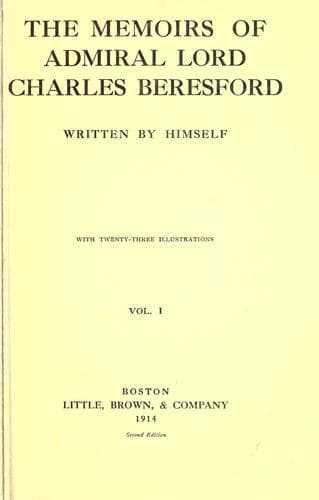
The Memoirs of Admiral Lord BeresfordBeresford, Charles William De la Poer Beresford, Baron
History
The Memoirs of Admiral Lord Beresford
Beresford, Charles William De la Poer Beresford, Baron
Admirals -- Great Britain -- Biography; Great Britain -- History, Naval -- 19th century
I shall never forget my first impressions, when, in 1874, I entered
Parliament. There was a discussion upon a matter of Local Government.
I listened to the speeches made on both sides of the House, each
speaker taking a different point of view, and I became more and more
doubtful concerning the solution of the problem in hand. At last a
Radical member, whose name I forget, drew all the yarns into one rope,
making what appeared to me to be a clear, concise and reasonable
proposal.
Sitting among my friends, several of whom had been at school with me, I
said:
"That is the only man who has solved the difficulty, and if he divides
I shall vote with him."
My innocent remark was received with a volley of expostulations. I was
told that I had only just joined political life, and that I did not
understand it; that the Radical speaker's plan was excellent, but that
the other side could not be allowed to take the credit of producing a
good scheme, because it would do our side harm in the country; that the
scheme would be thrown out for the time, in order that our side might
be able later on to bring in the same scheme and reap the credit of it,
and so forth.
"Well," I said, "if this kind of tactics is required in politics, it is
no place for me. I had better go back to sea."
Whereupon I was told that I should shake down to political methods when
I had been a year or two in the {139} House. But I have spent years in
politics and I have never shaken down to political methods. A thing is
either right or wrong. I have never scrupled to vote against my own
party when I thought they were in the wrong.
Upon one occasion, someone told Disraeli that I was intending to vote
against the party. He put his arm on my shoulder, and said in his
orotund, deliberate enunciation:
"My boy, don't you know that it's your first duty to vote with your
party? If everyone voted according to his convictions, there would be
no party system. And without a party system the Government could not
be carried on, as you will discover in time."
I have also discovered that when politicians think only of issues as
affecting themselves and not as affecting the State, party politics
fall to a very low level, and those who believe in great national and
Imperial ideas are regarded as freaks and faddists.
Disraeli was very friendly both to my brother Waterford and myself.
Upon the first occasion of a division in which I took part, he walked
through the lobby with his arm on my shoulder, rather to the surprise
of the old members.
"Who the devil is that young man to whom Dizzy is talking?" I heard
them murmur.
I sat immediately behind Disraeli; and one night, Lord Barrington, a
great friend of his, hurried into the House, and squeezing himself in
between me and the next man, leaned over and said to Disraeli in a
whisper:
"Poor Whyte-Melville has been killed!"
Disraeli turned slowly round, fitting his glass into his eye.
Public-domain text, read in full here on John Shaqi.
Reviews
Reviews
No reviews yet
Be the first to share your thoughts on this work.
Elsewhere in the archive
Join the Discussion
Join the discussion
Sign in to leave a comment or review.
Sign InorCreate an account