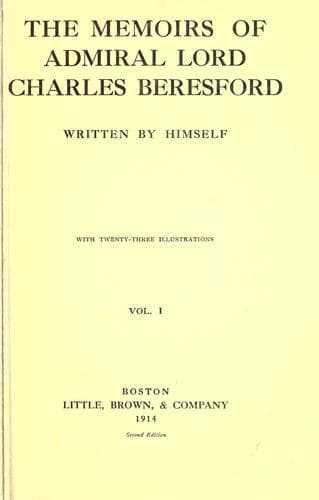
The Memoirs of Admiral Lord BeresfordBeresford, Charles William De la Poer Beresford, Baron
History
The Memoirs of Admiral Lord Beresford
Beresford, Charles William De la Poer Beresford, Baron
Admirals -- Great Britain -- Biography; Great Britain -- History, Naval -- 19th century
It was in this my first Parliament that Mr. Parnell emerged as the
leader of the Irish party. He was a cold, unapproachable person; he
kept his party under the most rigid control, with a tight hold upon the
purse. He had great ability. I have often seen him stalk into the
House in the middle of a debate, receive a sheaf of notes from his
secretary, Mr. O'Brien, with whom he would hold a whispered
consultation, then rise and deliver a masterly speech. He sat with me
on the committee of the Army Discipline Bill; speaking seldom, but
always to the point.
Lord Randolph Churchill entered Parliament at the same time as myself;
and he was always a great personal friend of mine.
Although we were opposed in politics, the other four Waterford members
were on excellent terms with the only anti-Home Ruler in the five.
There were Dick Power, F. H. O'Donnell, J. Delahunty, and Purcell
O'Gorman, who weighed twenty-eight stone or so; and they all came to my
wedding. Another Waterford man was Mr. Sexton. As a boy, he
manifested so brilliant a talent for oratory, that he was sent into
Parliament, where, as everyone knows, he speedily made his mark. I
remember, too, The O'Gorman Mahon, who, if I am not mistaken, fought
the last formal duel in this country.
When I entered Parliament the automobile torpedo was a comparatively
recent invention. Mr Whitehead had begun his experiments in 1864;
after four years' work and at the cost of £40,000, he produced the
formidable engine of war known as the Whitehead torpedo, the type from
which all subsequent improvements have been evolved. I have heard it
stated that the British Government could have bought the invention
right out for £60,000. Whitehead invented the device of using
hydrostatic pressure to regulate the depth of the immersion of the
torpedo, and employed compressed air {142} as its motive power. The
new weapon was adopted by the British Navy and by other naval powers.
In the year 1876 the type in use was the 14-in., length 14 ft. 6 in.,
weight 525 lbs.
In my view, the capabilities of the new weapon had not been fully
appreciated; that opinion may or may not have been justified; but I
considered it to be my duty publicly to insist upon the importance of
the torpedo in naval warfare. I spoke on the subject both inside the
House of Commons and on the platform, and was so fortunate as to win
the approval of _The Times_.
Public-domain text, read in full here on John Shaqi.
Reviews
Reviews
No reviews yet
Be the first to share your thoughts on this work.
Elsewhere in the archive
Join the Discussion
Join the discussion
Sign in to leave a comment or review.
Sign InorCreate an account