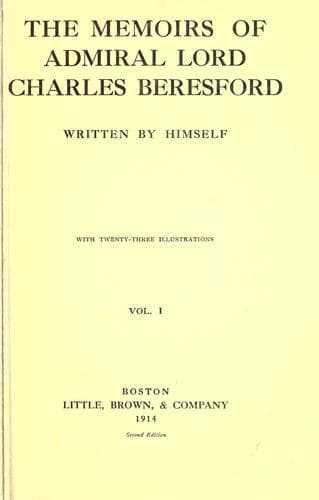
The Memoirs of Admiral Lord BeresfordBeresford, Charles William De la Poer Beresford, Baron
History
The Memoirs of Admiral Lord Beresford
Beresford, Charles William De la Poer Beresford, Baron
Admirals -- Great Britain -- Biography; Great Britain -- History, Naval -- 19th century
The Admiralty, however, were deeply affronted. The First Lord, Mr.
George Ward Hunt, informed me that the Board took great exception to my
speaking in the House upon naval subjects, and desired me to understand
that I must choose between the career of a sailor and that of a
politician. My reply was that I considered the request to be a breach
of privilege. Mr. Ward Hunt admitted the point; but argued that the
employment in the House of Commons of my knowledge of the Service was
prejudicial to discipline. He was of course right in so far as the
conditions did undoubtedly afford opportunities for prejudicing
discipline; but as there was no regulation forbidding a naval officer
to sit in Parliament, a dual position which had been frequently held by
members of the Board of Admiralty, the responsibility rested upon the
individual.
However, it was not a case for argument; and I appealed directly to Mr.
Disraeli, telling him that I regarded the request of the Admiralty as a
breach of privilege; that I had no intention of relinquishing my naval
career; and that I had entered Parliament solely in the interests of
the Service. Disraeli listened with his customary sardonic gravity.
"What," he asked, "do you intend to do?"
I said that if the matter were pressed to a conclusion, I should resign
my seat, in which event Waterford would very probably be captured by a
hot Home Ruler.
"My dear boy," said Disraeli, in his deliberate way, "I {143} am quite
sure that you will do nothing heroic. I," he added,--"I will see the
Secretariat."
And that was the last I heard of the affair.
Among other Service matters in which I did what I could in the House of
Commons to obtain reforms, were the training of the personnel, the more
rapid promotion of officers, promotion from the lower deck to officers'
rank, and the necessity for building fast cruisers to protect the trade
routes. I advocated more time being spent by the men upon gunnery
training, and less upon polishing bright-work; and brought forward a
motion to stop the men of the Fleet "doing 'orses" (as they called
hauling carts laden with stores about the dockyard), instead of being
trained in their proper work. These subjects no longer possess any
interest save in so far as the circumstances resemble those of the
present day. But I find recurring to-day many of the difficulties of
thirty or forty years ago.
Public-domain text, read in full here on John Shaqi.
Reviews
Reviews
No reviews yet
Be the first to share your thoughts on this work.
Elsewhere in the archive
Join the Discussion
Join the discussion
Sign in to leave a comment or review.
Sign InorCreate an account