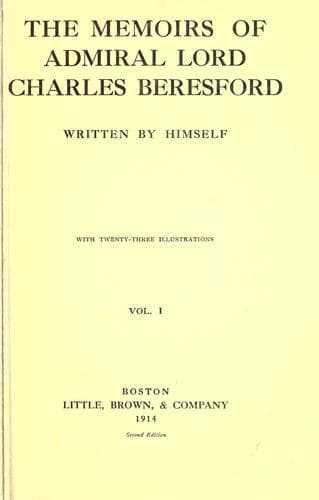
The Memoirs of Admiral Lord BeresfordBeresford, Charles William De la Poer Beresford, Baron
History
The Memoirs of Admiral Lord Beresford
Beresford, Charles William De la Poer Beresford, Baron
Admirals -- Great Britain -- Biography; Great Britain -- History, Naval -- 19th century
At that time the Admiralty had abolished the short service system under
which highly efficient seamen were recruited direct from the mercantile
marine, and the Board had become responsible for the whole supply and
training of men for the Fleet. But the Admiralty had neglected to
constitute an efficient system of training. A very large proportion of
men were employed at sea upon duties which precluded them from
receiving war training of any kind; another large contingent was kept
idle in hulks and receiving ships while waiting to be drafted into
sea-going vessels. The suggestion was that barracks should be erected
for their accommodation and provided with attached vessels; and that a
complete system of training should be organised; so that every man upon
going to sea in a ship of war should be acquainted with his duties.
Commander Noel (now Admiral of the Fleet Sir Gerard H. U. Noel, K.C.B.,
K.C.M.G.) kindly sent to me a most valuable memorandum upon the
subject, in which he presented an admirable scheme of organisation, the
principles of which were afterwards carried into execution. Of late
years those principles have been {144} infringed; but the exigencies of
the Service will compel the authorities to return to the essential
conditions laid down by Sir Gerard Noel, whose authority is entitled to
the greatest respect. I also received a sagacious letter on the same
subject from Commodore John Wilson, under whom I afterwards served as
commander in the _Thunderer_, indicating the necessity of framing a
scheme of organisation to come into force as soon as the barracks were
completed.
With regard to the promotion of officers and men, the state of things
nearly forty years ago finds a parallel to-day. Then, as now, a very
large proportion of officers, from the rank of commander downwards,
cannot hope to be promoted. It was then suggested that the retiring
allowance should be increased. It is true that in 1873 Mr. Goschen, by
granting an increased retiring allowance for a limited period, had done
his best to effect a temporary relief. But the permanent reform, which
is more necessary now than ever before, still awaits achievement. In
the meantime the discontent to which I drew attention in 1875, is by no
means less detrimental than it was. The whole difficulty, as usual, is
financial. Government after Government, of what political complexion
soever, refuse to pay the Services properly. The condition of affairs
is a national disgrace.
At that time, too, the Fleet was highly deficient in cruisers; and, in
consequence, the sea-borne trade of the country was exposed to great
danger in the event of war, as I explained to the House of Commons. In
later years the requisite ships were provided; only, in a moment of
retrograde impulse, to be abolished. After a period of insecurity and
uneasiness, the cruiser force is once more being slowly increased.
Public-domain text, read in full here on John Shaqi.
Reviews
Reviews
No reviews yet
Be the first to share your thoughts on this work.
Elsewhere in the archive
Join the Discussion
Join the discussion
Sign in to leave a comment or review.
Sign InorCreate an account