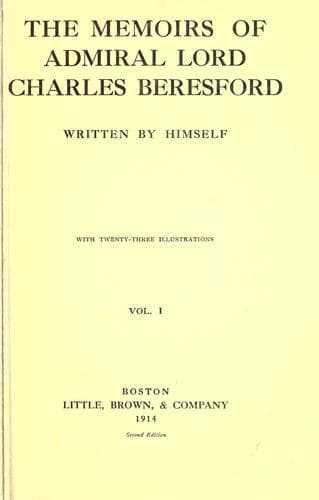
The Memoirs of Admiral Lord BeresfordBeresford, Charles William De la Poer Beresford, Baron
History
The Memoirs of Admiral Lord Beresford
Beresford, Charles William De la Poer Beresford, Baron
Admirals -- Great Britain -- Biography; Great Britain -- History, Naval -- 19th century
I was accordingly appointed to the _Thunderer_ as commander. Her
captain was John Crawford Wilson (afterwards Rear-Admiral). The Navy
lost one of the best officers that ever sailed the seas when he died in
1885. He {147} was mentioned in the Admiral's dispatch for gallant
conduct in the affair of the Peiho Forts in 1859, served on the Pacific
Station, and was commodore of the Australian station. He was commander
of the _Bombay_ screw wooden first-rate, when she was burned off
Montevideo on the 14th December, 1864, and when 97 officers and men
perished. Many of those who were lost had climbed out on the bowsprit,
and when they were forced overboard by the heat, the melting lead of
the gammoning (the lead covering to the chain gammoning securing the
bowsprit) dropped on them and killed them. It was largely due to the
splendid discipline maintained by Wilson that the loss was not far
greater. The men held their posts although the flames were licking up
through the skids, so that the falls of the last boat, lowered from the
yard-arm, were actually burned through. It should be added that in
this disaster the Royal Marines enhanced their unrivalled reputation,
34 out of 97 lost belonging to the corps, the sentries dying at their
posts.
The _Thunderer_ was of 9190 (4407) tons, 6270 (800) h.p., and belonged
to the Channel Squadron. She was an improved central battery
twin-screw ironclad, designed, with the vessels of a similar type,
_Devastation_ and _Dreadnought_, by Mr. E. T. Reed, C.B. In these
ships there was no propulsion by mast and sail power. They also
embodied the idea of limiting the armament to heavy guns, the secondary
armament of lighter guns being omitted. This arrangement, after having
been wisely abandoned for many years, was repeated in the _Dreadnought_
of the year 1906, only to be once more recognised as a mistake. One of
many reasons why a secondary armament was essential, particularly with
muzzle-loading guns, was that, lacking it, the men might have been
exposed to the enemy's fire for some time before they could reply, a
most demoralising position. These considerations were constantly
represented by Captain Wilson to the Admiralty. While the science of
gunnery progressed, the element of time has remained a {148} factor in
the problem, though under different circumstances. The _Thunderer_
carried two pairs of muzzle-loading guns in two turrets; the foremost
pair being 38-ton guns, hydraulic loading, the after pair 35-ton guns,
hand-loading. She was belted with 14-inch armour along the water line;
and the armour projecting squarely from the hull, its edge struck the
water so hard when the ship rolled, that she was shaken throughout her
structure. To remedy this defect, wedge-shaped pieces were fitted
along the lower edge of the armour. Before I joined the ship she had
burst a boiler, the escaping steam causing great loss of life. Captain
Wilson, who was in the engine-room at the time, was saved by his
Public-domain text, read in full here on John Shaqi.
Reviews
Reviews
No reviews yet
Be the first to share your thoughts on this work.
Elsewhere in the archive
Join the Discussion
Join the discussion
Sign in to leave a comment or review.
Sign InorCreate an account