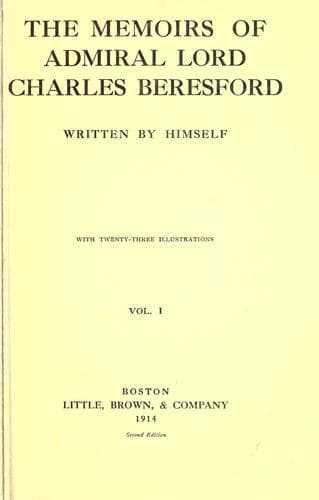
The Memoirs of Admiral Lord BeresfordBeresford, Charles William De la Poer Beresford, Baron
History
The Memoirs of Admiral Lord Beresford
Beresford, Charles William De la Poer Beresford, Baron
Admirals -- Great Britain -- Biography; Great Britain -- History, Naval -- 19th century
Seven years afterwards, I visited India again. It seemed to me that in
the interval the relations between the Indian and the Englishman had
changed for the better; in that the natives were less afraid of the
white man, and that a better feeling had grown up between East and
West. The principle upon which India is governed is the principle of
establishing justice and humanity. India is governed by the sword; but
the sword is sheathed.
{170}
CHAPTER XVIII
THE EGYPTIAN WAR
I. THE BEGINNING OF TROUBLE
NOTE
The story of the Egyptian war may conveniently begin with an account of
the affair of the 9th September, 1881, when Tewfik, Khedive of Egypt,
met Arabi Pasha face to face in the Square of Abdin at Cairo, and
failed to take advantage of the greatest opportunity of his life. Had
he acted there and then upon the counsel of Mr. (afterwards Sir)
Auckland Colvin, British Controller, it is possible that the Egyptian
war might have been avoided.
The beginning of the trouble was the jealousy existing between the
native Egyptian and the Turkish, or Circassian, elements of the army.
Rightly or wrongly, the Egyptian, or fellah, officers believed
themselves to be slighted. The Turkish, or Circassian, officers, being
of the same race as the ruling family, regarded themselves as the
dominant caste. In the time of Ismail Pasha, the predecessor of
Tewfik, the Minister of War, Osman Pasha Rifki, a Circassian, perceived
that his dignity was compromised by his being obliged to receive orders
from the Khedive through Ali Fehmi, captain of the Guards at the
Palace, a fellah. In the East, such a situation does not continue.
Ali Fehmi mysteriously fell into disgrace. Naturally, he had a
grievance; and he joined himself to two other officers of his race, who
also had {171} grievances. These were Abdel-el-Al and Ahmed Arabi, who
was to become better known as Arabi Pasha. They were called the "Three
Colonels," and to them came Mahmoud Sami Pasha, an exceedingly astute
politician.
Arabi's particular injury was that he had been punished by Ismail for
creating a disturbance under the Palace windows, when he was one of the
officers of the guard. Ismail had bluntly remarked that Arabi was more
noisy but less useful than the big drum. Arabi joined a secret society
of discontented officers, and shortly afterwards again fell into
trouble under a charge of corruption while he was in command of
transports during the war between Egypt and Abyssinia. Subsequently,
Ismail allowed Arabi to join a regiment, whereupon he became chief of
the secret society. One of its members divulged the secret to the
Khedive, who adopted the Oriental method of buying the allegiance of
the disaffected officers by promoting in one day seventy of them to be
lieutenant-colonels. He also presented one of his slaves to Arabi to
wife.
Public-domain text, read in full here on John Shaqi.
Reviews
Reviews
No reviews yet
Be the first to share your thoughts on this work.
Elsewhere in the archive
Join the Discussion
Join the discussion
Sign in to leave a comment or review.
Sign InorCreate an account