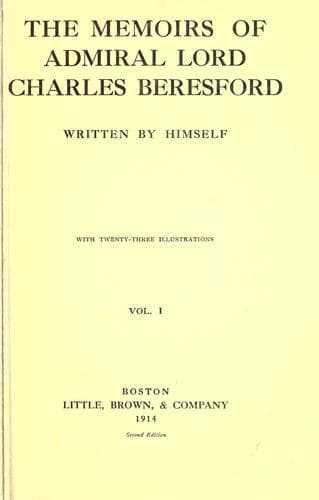
The Memoirs of Admiral Lord BeresfordBeresford, Charles William De la Poer Beresford, Baron
History
The Memoirs of Admiral Lord Beresford
Beresford, Charles William De la Poer Beresford, Baron
Admirals -- Great Britain -- Biography; Great Britain -- History, Naval -- 19th century
So much for Ismail Pasha. When, by order of the Sultan, he was
superseded by Tewfik, Arabi made haste to do obeisance to the new
Khedive, who made him a full colonel. But when Tewfik reduced the
army, the Three Colonels presented a petition to the Khedive,
demanding, among other matters, that an Egyptian should be made
Minister of War in place of Osman Rifki. The Three Colonels were
thereupon arrested. Mahmoud Sami Pasha, a member of the Cabinet,
secretly arranged that when they were brought before the Court-martial,
the soldiers should rescue them. On the 1st February, 1881,
accordingly, the soldiers burst into the court, turned it inside out,
and carried the Three Colonels to the Palace. The Khedive, confronted
with physical force to which he had nothing to oppose, consented to
supersede his War Minister in favour of the crafty Mahmoud Sami, to
increase the army by 18,000 men, and to abolish favouritism.
The Khedive very soon discovered that Mahmoud Sami {172} was by no
means a desirable Minister of War, and also that the Three Colonels and
their friends continued to stir up trouble. He therefore dismissed
Mahmoud Sami and appointed in his stead the Khedive's brother-in-law,
Daoud Pasha, a Circassian, and ordered the disaffected regiments to
leave Cairo. At the same time it was rumoured that the Khedive had
obtained a secret decree from the Sultan condemning Arabi and his
friends to death. When the order to remove his regiment from Cairo was
received by Arabi, that leader of revolt informed the Minister of War
on 9th September, 1881, that the troops in Cairo would proceed the same
afternoon to the Palace of Abdin, there to demand of the Khedive the
dismissal of the Ministry, the convocation of the National Assembly,
and the increase of the army. Then came Tewfik's opportunity, which,
as already observed, he let slip.
When the Khedive entered the Square, accompanied by Mr. Colvin, British
Controller, and a few native and European officers, he was confronted
with some 4000 soldiers and thirty guns. The following account of the
critical moment is given by the Hon. Charles Royle, in his excellent
history of _The Egyptian Campaigns_ (London, 1900).
"The Khedive advanced firmly towards a little group of officers and men
(some of whom were mounted) in the centre. Colvin said to him, 'When
Arabi presents himself, tell him to give up his sword and follow you.
Then go the round of the regiments, address each separately, and give
them the "order to disperse."' The soldiers all this time were
standing in easy attitudes, chatting, laughing, rolling up cigarettes,
and eating pistachio nuts, looking, in fact, as little like desperate
mutineers as could well be imagined. They apparently were there in
obedience only to orders, and, without being either loyal or disloyal,
might almost be regarded as disinterested spectators.
Public-domain text, read in full here on John Shaqi.
Reviews
Reviews
No reviews yet
Be the first to share your thoughts on this work.
Elsewhere in the archive
Join the Discussion
Join the discussion
Sign in to leave a comment or review.
Sign InorCreate an account