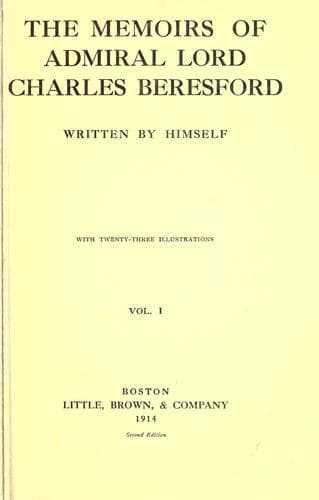
The Memoirs of Admiral Lord BeresfordBeresford, Charles William De la Poer Beresford, Baron
History
The Memoirs of Admiral Lord Beresford
Beresford, Charles William De la Poer Beresford, Baron
Admirals -- Great Britain -- Biography; Great Britain -- History, Naval -- 19th century
In the course of these reconnaissances, large quantities of stores and
ammunition were found in the neighbouring villages. About three miles
from the lines, an immense store of gun-cotton and Abel's detonators
was discovered in a quarry among the low hills, stored in a shed. As
no hostile force appeared during the next two days, I determined to
destroy the gun-cotton. Captain A. K. Wilson of the _Hecla_ sent 20
bluejackets and six Marines to assist me. These were embarked and
landed within half a mile of the place. Outposts were set, with orders
to signal should the enemy appear, and the rest of the party set to
work.
{204}
Although gun-cotton does not, strictly speaking, explode except by
detonation, it is extremely difficult to define where ignition ends and
detonation begins; and there had been instances of its explosion,
supposed to be due to the internal pressure of a large mass. A
tremendous explosion of gun-cotton had occurred in 1866 at Stowmarket,
where its manufacture was being carried on under the patent of Sir
Frederick Abel, then chemist to the War Office. On another occasion,
when Sir Frederick was conducting an experiment designed to prove that
ignition was harmless, he had his clothes blown off his body, and
narrowly escaped with his life. Recollecting these things, I thought
it advisable to spread the stuff in a loose mass upon the hillside
sloping to the quarry. The gun-cotton was packed in boxes. These were
unpacked, and the contents were spread on the ground. Next to the
pile, a bucket of loose powder was poured on the ground and over the
fuse, to make sure of ignition. Into the powder was led one end of a
Bickford's fuse, which was then threaded through the discs of
gun-cotton. The fuse was timed to burn for five minutes.
The work was highly exhausting to the men, and more than once I felt
inclined to call in the outposts to help; but I decided that it would
not be right to take the risk of a surprise attack; for we were working
in a trap, being closed in by the quarries on one side and by the low
hills on the other. And sure enough, when the men had been working for
five hours, up went the outpost's signal, and the corporal of Marines
with his three men came running in to report that large numbers of the
enemy were in sight.
Public-domain text, read in full here on John Shaqi.
Reviews
Reviews
No reviews yet
Be the first to share your thoughts on this work.
Elsewhere in the archive
Join the Discussion
Join the discussion
Sign in to leave a comment or review.
Sign InorCreate an account