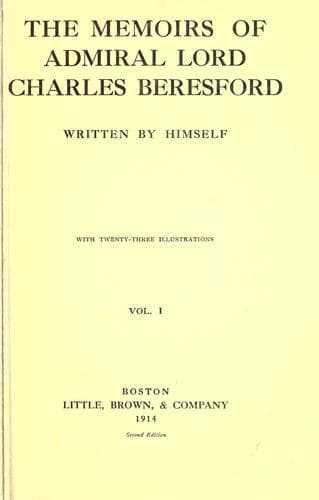
The Memoirs of Admiral Lord BeresfordBeresford, Charles William De la Poer Beresford, Baron
History
The Memoirs of Admiral Lord Beresford
Beresford, Charles William De la Poer Beresford, Baron
Admirals -- Great Britain -- Biography; Great Britain -- History, Naval -- 19th century
Hastening out, I saw about 50 scouts running up, an action so unusual
that it was evident they were strongly supported. Presently, about 200
skirmishers appeared, and behind them a large body of cavalry, probably
about 700 in number. The outposts were at once recalled. The men were
ordered out of the quarry, divided into two companies {205} of twelve
men each, and retired by companies over the hill towards the shore, out
of sight of the enemy. Mr. Attwood, the gunner of the _Hecla_, a
bluejacket and myself, remained to fire the fuse. It was a five-minute
fuse. The retreating men had been told to count as they ran, and at
the end of four minutes, or when they saw us lie down, to halt and lie
down. I gave the order in case there should be an explosion. When the
men were lying down, I fired the fuse. Then the gunner, the bluejacket
and I ran about 300 yards, and flung ourselves down.
Then there came a noise as though a giant had expelled a huge breath;
the blast of the ignition burned our cheeks; in the midst of a vast
column of yellow smoke, boxes and pieces of paper were whirling high in
air, and a strong wind sucked back into the vacuum, almost dragging us
along the sand. The enemy were so interested in the spectacle that
they gave us time to get back to the boats.
It is probable that information had been given to the hostile forces by
the inhabitants of the village past which we went to reach the quarry
where was the gun-cotton; for, in retreating to the boats, when I
looked back, instead of the 20 or 30 native women who were usually
sitting about the place, I saw about 200 men eagerly watching us from
the house-tops, evidently in the hope of enjoying the gratifying
spectacle of our destruction.
From the summit of the slope falling to the sea, I signalled to the
flagship, with a handkerchief tied to a pole, that I was surrounded:
one of the many occasions upon which a knowledge of signalling proved
invaluable. There was a haze upon the water, and I could not clearly
discern the answering signal; but the signalman of the flagship had
seen my figure silhouetted on the sky-line. Instantly after, Captain
John Fisher of the _Inflexible_ manned and armed boats, came ashore,
and the enemy immediately retreated.
Shortly afterwards, as I was now a captain, I was relieved of the
command of the _Condor_ by Commander {206} Jeffreys, and went on
half-pay. I should naturally have much preferred to remain in my
little ship; but she was not a captain's command; and I left her (as I
see I wrote at the time) with a tear in each eye. Commander Jeffreys
discovered the place where she had been hit during the bombardment, one
of her under-water plates having been started. Until then, it was
thought that the only damage consisted of a hole through her awning and
the smashing of a boat.
At the conclusion of this period of my service, I was most gratified to
receive a gracious message of congratulation from Her Majesty the Queen.
Public-domain text, read in full here on John Shaqi.
Reviews
Reviews
No reviews yet
Be the first to share your thoughts on this work.
Elsewhere in the archive
Join the Discussion
Join the discussion
Sign in to leave a comment or review.
Sign InorCreate an account