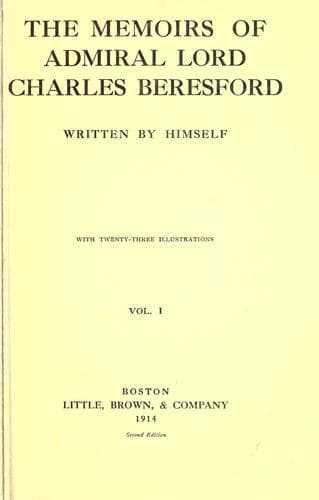
The Memoirs of Admiral Lord BeresfordBeresford, Charles William De la Poer Beresford, Baron
History
The Memoirs of Admiral Lord Beresford
Beresford, Charles William De la Poer Beresford, Baron
Admirals -- Great Britain -- Biography; Great Britain -- History, Naval -- 19th century
In January, 1883, Colonel W. Hicks, afterwards Hicks Pasha, was
appointed by the Khedive chief of the staff of the Army of the Soudan.
Before he proceeded to the theatre of war, Abdel Kader had lost and won
various engagements, and had reoccupied the province of Sennar; while
the Mahdi had taken El Obeid and Bara and occupied the whole of
Kordofan.
In February, it was announced in the Queen's Speech that "the British
troops will be withdrawn as promptly as may be permitted by a prudent
examination of the country"; a declaration provoking intense alarm
among the European {213} inhabitants of Egypt. Their protests,
however, were totally disregarded. The Egyptians naturally concluded
that England owned no real interest in that reform of administration
which her influence alone could achieve.
On 7th February, 1883, Colonel Hicks left Cairo for Khartoum, with his
staff, consisting of Colonels Colborne and De Coetlogon, Majors
Farquhar and Martin, and Captains Warner, Massey and Forrestier-Walker.
Upon the night before their departure, Colonel Hicks and his staff
dined with Lord and Lady Charles Beresford in Cairo. Lord Charles
Beresford, who was then on half-pay, had expressed a wish to accompany
Colonel Hicks, but Lord Dufferin disapproving of his suggestion, Lord
Charles Beresford withdrew it.
Hicks and his men disappeared into the desert, which presently
swallowed them up.
On the 28th April, Hicks defeated a large force of the Mahdi's army on
the White Nile. The Egyptian Government then decided to reconquer the
province of Kordofan, and dispatched reinforcements to Khartoum. On
the 9th September, Hicks Pasha, at the head of 10,000 men, marched for
Duem. The last dispatch received from him was dated 3rd October, 1883.
Upon a day early in November, Hicks and his whole army were annihilated.
His defeat left Khartoum in great danger. On 9th November, before the
news of the disaster reached England, the British Government stated
that all British troops were to be withdrawn from Egypt. When the fact
was known, the decision of the Government was modified; but they still
declined to interfere in the Soudan; and advised the Egyptian
Government to evacuate at least a part of that territory. The Egyptian
Government protesting, the British Government, on 4th January, 1884,
sent a peremptory message insisting that the policy of evacuation
should be carried into execution. The inconsequence of Her Majesty's
Ministers is sufficiently apparent.
Public-domain text, read in full here on John Shaqi.
Reviews
Reviews
No reviews yet
Be the first to share your thoughts on this work.
Elsewhere in the archive
Join the Discussion
Join the discussion
Sign in to leave a comment or review.
Sign InorCreate an account