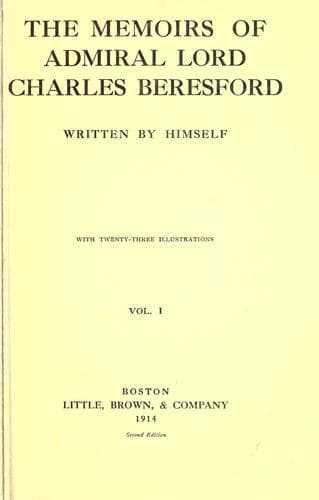
The Memoirs of Admiral Lord BeresfordBeresford, Charles William De la Poer Beresford, Baron
History
The Memoirs of Admiral Lord Beresford
Beresford, Charles William De la Poer Beresford, Baron
Admirals -- Great Britain -- Biography; Great Britain -- History, Naval -- 19th century
In the meantime, during August of the preceding year, {214} 1883,
trouble had arisen in the Eastern Soudan, where Osman Digna, a trader,
joined the Mahdi, and brought all the tribes of that country to his
standard. At the beginning of November, 1883, just at the time when
Hicks Pasha and his army had come to their end, an Egyptian force under
Mahmoud Talma Pasha was defeated by Osman Digna in the attempt to
relieve Tokar, besieged by the rebels, Captain Moncrieff, Royal Navy,
British Consul at Souakim, being killed in the action. A second
expeditionary force under Suleiman Pasha was cut to pieces on 2nd
December at Tamanieh.
The Egyptian Government then dispatched reinforcements under the
command of General Valentine Baker, among whose staff were Colonel
Sartorius, Lieutenant-Colonel Harrington, Lieutenant-Colonel Hay,
Majors Harvey, Giles, and Holroyd, Morice Bey and Dr. Leslie. On the
4th February, 1884, Baker was defeated at El-Teb, with the loss of
nearly two-thirds of his force. Morice Bey, Dr. Leslie, and nine other
European officers were killed. Souakim being threatened, Admiral
Hewett, on 10th December, was given the command of the town, having
under him some 3800 troops. Two days later came the news of the taking
of Sinkat by the rebels, and of the massacre of the garrison. During
the period in which these successive disasters occurred, the British
Army of Occupation was kept idle in Cairo by the orders of the British
Government.
The current of events now divides, one leading to Khartoum, the other
still flowing in the Eastern Soudan. The British Government,
hopelessly at fault, turned to General Charles Gordon, as the one man
in the world who could apparently perform miracles. Ten years
previously, "Chinese" Gordon, as Governor-General of the Soudan, and
again in 1877, as Governor-General of the Soudan, Darfur and the
Equatorial Provinces, had freed the country from Turkish rule, broken
the slave trade, established peace, opened trade routes, and laid the
foundations of civilisation. Since 1877 he had been engaged in setting
wrong things right in Egypt {215} in the Soudan again, in Abyssinia, in
China, in the Mauritius, at the Cape, in Palestine, and in the Congo.
On 18th January, 1884, Gordon was instructed by the British Government
to report upon the best method of evacuating the Soudan. When he
arrived at Cairo, these instructions were radically altered by Sir
Evelyn Baring (afterwards Lord Cromer), who, on the 25th January,
informed Gordon that he was required actually to direct the evacuation
of Khartoum and of the whole Soudan, and afterwards to establish an
organised government in that country. Gordon arrived at Khartoum on
the 18th February, where he was hailed as the father and saviour of the
people.
Public-domain text, read in full here on John Shaqi.
Reviews
Reviews
No reviews yet
Be the first to share your thoughts on this work.
Elsewhere in the archive
Join the Discussion
Join the discussion
Sign in to leave a comment or review.
Sign InorCreate an account