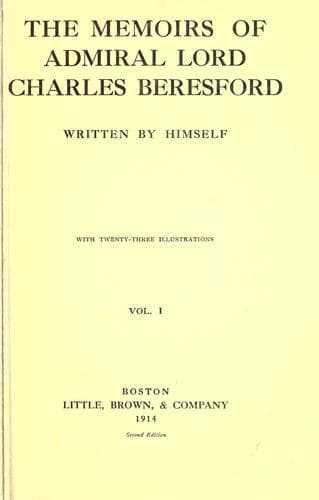
The Memoirs of Admiral Lord BeresfordBeresford, Charles William De la Poer Beresford, Baron
History
The Memoirs of Admiral Lord Beresford
Beresford, Charles William De la Poer Beresford, Baron
Admirals -- Great Britain -- Biography; Great Britain -- History, Naval -- 19th century
Even now, the Government failed to recognise the plain facts of the
case. Their instructions to Lord Wolseley were that the main object of
the expedition was to rescue General Gordon. Her Majesty's Ministers
considered that it might be practicable to achieve his release without
going to Khartoum, and that in any case it was desirable to avoid any
fighting so far as possible.
When Lord Wolseley started from Cairo on 27th September, 1884, the
advance was already going rapidly forward. Under the direction of Sir
Evelyn Wood and Commander Hammill, a number of the whaler boats had
been transported to Wady Halfa, which is nearly 900 miles from
Khartoum, the total length of the Nile route being 1650 miles. Along
the river, up to Wady Halfa and a little beyond to Sarras, bases of
supply had been established; an advance guard was already at New
Dongola, about 100 miles above Wady Halfa, under the command of General
Sir Herbert Stewart, he who afterwards led the Desert Column.
Arriving at Wady Halfa on 5th October, Lord Wolseley received news that
Colonel J. S. Stewart, Mr. Power, British Consul at Khartoum and
correspondent of _The Times_, M. Herbin, French Consul, and a party of
Greek and Egyptian refugees, who had left Khartoum in the steamer
Abbas, had all been slain. Stewart had with him Gordon's papers,
which, of course, were taken by the Mahdi's men.
On the 8th October a letter from M. Herbin was received at Cairo. It
was dated from Khartoum, 29th July, 1884, and stated that there were
then provisions for two months in the {219} place. The time had thus
expired--and M. Herbin had been murdered--ere the letter arrived.
A temporary base was formed at Wady Halfa; and bases of supplies were
established along the river up to New Dongola. By means of
extraordinary exertions, boats and steamers were hauled up to Dongola
through the rapids. Lord Wolseley formed a Camel Corps of 1500 men,
consisting of four regiments, Heavy Cavalry, Light Cavalry, Guards, and
Mounted Infantry, with a detachment of Royal Marines. Early in
November, a general advance was made from Wady Halfa. Wolseley arrived
at Dongola on 3rd November. Two days previously, on 1st November, Sir
Evelyn Baring had received a message from Gordon, dated 13th July,
saying that he could hold out for four months. The limit, therefore,
had nearly been reached by the time the expedition was leaving Wady
Halfa, 900 miles from Khartoum.
Public-domain text, read in full here on John Shaqi.
Reviews
Reviews
No reviews yet
Be the first to share your thoughts on this work.
Elsewhere in the archive
Join the Discussion
Join the discussion
Sign in to leave a comment or review.
Sign InorCreate an account