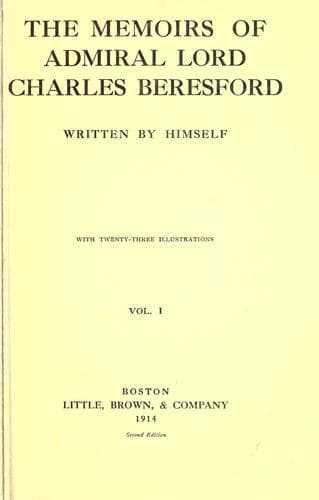
The Memoirs of Admiral Lord BeresfordBeresford, Charles William De la Poer Beresford, Baron
History
The Memoirs of Admiral Lord Beresford
Beresford, Charles William De la Poer Beresford, Baron
Admirals -- Great Britain -- Biography; Great Britain -- History, Naval -- 19th century
Lord Wolseley, early in November, considered that it would take to the
end of the year to concentrate his forces at Ambukol, just above Old
Dongola. He returned to Wady Halfa to expedite progress; and by the
middle of December headquarters were established at Korti, and by
Christmas the greater part of the force was concentrated there. During
the whole of this period, Wolseley's army must be figured as a river of
men flowing along the river Nile, the infantry struggling up in boats,
the mounted men toiling along the banks; the stream of men banking up
at headquarters, the military front, which is steadily pushed forward
from Wady Halfa to New Dongola, from New Dongola to Old Dongola 60 to
70 miles farther up, from Old Dongola to Korti.
On 17th November a letter was received from Gordon saying that he could
hold out for forty days from the date of the superscription, 4th
November, 1884, thus leaving Wolseley barely four weeks to accomplish a
task needing as many months. On 28th November another letter from
Gordon, dated 9th September, gave the relief expedition four months,
thus leaving Wolseley five weeks from the {220} date upon which the
letter was received. It was now clear that the expedition could not
reach Khartoum in time.
When Lord Wolseley, towards the end of December, had his forces
concentrated at Korti, he decided to divide them into two columns, the
Desert Column and the Nile Column. The reasons for his scheme can only
be clearly apprehended by a reference to the map. At Korti, the Nile
turns north-east, looping back again, and resuming its southward course
at Metemmeh. A straight line drawn across the Bayuda Desert from Korti
to Metemmeh is the short cut. This was the route given to the Desert
Column. The Nile Column was to proceed up the loop of the river to
Hamdab, there to avenge the murder of Colonel Stewart and his party, to
proceed higher up to Berti, and thence to secure the bend of the river
and to open up the desert route back to Korosko, below Wady Halfa, and
from Korosko it was intended to attack Berber, and thence to join
forces with the Desert Column at Metemmeh.
The Nile Column, numbering about 3000 men, under the command of
Major-General Earle, Brigadier-General Brackenbury being second in
command, left Korti on 28th December, 1884.
The Desert Column was placed under the command of General Sir Herbert
Stewart. With him was Colonel Sir Charles Wilson, who was instructed
to take a body of troops from Metemmeh to Khartoum. The Column
consisted of sections of the Camel Corps, a company of the Royal
Engineers, a detachment of the 19th Hussars, detachments of the
Commissariat and Medical Corps, and the Naval Brigade, which was placed
under the command of Lord Charles Beresford. The total force numbered
73 officers, 1032 non-commissioned officers and men, 2099 camels, and
40 horses. The Desert Column left Korti on 30th December, 1884. It
was, in fact, a forlorn hope.
Public-domain text, read in full here on John Shaqi.
Reviews
Reviews
No reviews yet
Be the first to share your thoughts on this work.
Elsewhere in the archive
Join the Discussion
Join the discussion
Sign in to leave a comment or review.
Sign InorCreate an account