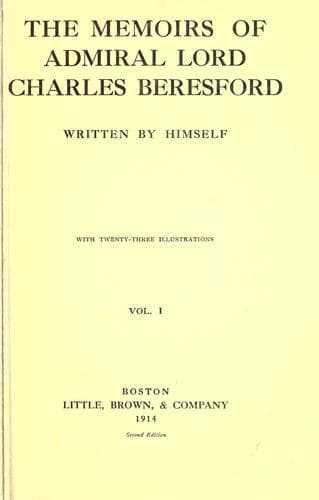
The Memoirs of Admiral Lord BeresfordBeresford, Charles William De la Poer Beresford, Baron
History
The Memoirs of Admiral Lord Beresford
Beresford, Charles William De la Poer Beresford, Baron
Admirals -- Great Britain -- Biography; Great Britain -- History, Naval -- 19th century
I invented a saddle for camels, and I believe the pattern is still in
use. The saddle-tree is a triangular wooden framework, like the gable
of a roof. I covered the wood with oakum and canvas; abolished all
buckles, made the girths and stirrups of raw hide thongs, and put the
stirrups forward, instead of behind. Count Gleichen, in his
interesting book, _With the Camel Corps up the Nile_, relates how the
saddles and equipment served out to the Camel Corps gave the men
infinite trouble and discomfort. The unseasoned wood came to pieces,
the straps broke, the water-skins and water-bottles leaked; but one
instance of the departmental mismanagement which caused our men so much
unnecessary suffering.
By the end of November, the river was falling so swiftly that what was
smooth water yesterday was to-day a {238} frivolous series of
waterfalls with a twist in them. Every alteration in the river
involved a new device for haulage, and it would alter at three or four
places in a mile, and there were 11 miles of rapids. I was generally
able to judge by the look of the water when and where it would change
its course during the next few hours. In order to avoid the least
delay, new arrangements must be devised beforehand; and my mind was so
absorbed in these schemes, that I dreamed of them nightly. By that
time I had 1400 men working under me, whose work must be organised, and
stations allocated. The Bab-el-Kebir, that formidable rapid, was now a
grazing ground for goats.
I shifted my quarters from the Bab to Wady Halfa, as the difficulties
were now all at that end of the Cataract. Peel and Colbourne, in
command respectively of the next two reaches, found no day too long and
no work too hard.
In order to supervise the whole length of the operations as quickly as
possible, I kept one camel, Ballyhooly, at the Bab; the big white
donkey County Waterford half-way there; and Bimbashi the bold and
Beelzebub at Wady Halfa. Bimbashi could trot 16 miles in the hour. A
Bedouin Sheikh offered me £3$ for him. As I had bought him for £24 I
concluded that his vender had stolen him. I won more than his price in
the race with Colonel Brocklehurst's Sheikh. While at Wady Halfa I
rode him six miles out in the heavy sand against Sir Evelyn Wood and
his A.D.C., who rode horses, and Bimbashi beat the horses fair and
square.
Lord Wolseley sent me a telegram ordering me to form a naval brigade of
100 men and 10 officers. But as the bluejackets were of inestimable
service in getting the remainder of the boats through the Cataract, and
fitting them out at Gemai, where the soldiers embarked, he desired to
keep them where they were as long as possible. On 27th November, we
hoped to get all the boats through during the next five days. Up to
that date--the last for which I have a note--687 boats had been passed
through the Cataract, with {239} a loss of 4 only; about 27 men of all
sorts had been drowned; and 337 boats had left Gemai with troops and
stores.
Public-domain text, read in full here on John Shaqi.
Reviews
Reviews
No reviews yet
Be the first to share your thoughts on this work.
Elsewhere in the archive
Join the Discussion
Join the discussion
Sign in to leave a comment or review.
Sign InorCreate an account