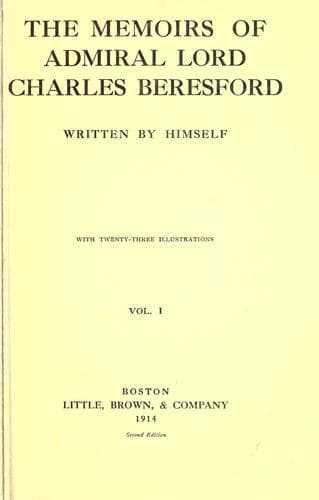
The Memoirs of Admiral Lord BeresfordBeresford, Charles William De la Poer Beresford, Baron
History
The Memoirs of Admiral Lord Beresford
Beresford, Charles William De la Poer Beresford, Baron
Admirals -- Great Britain -- Biography; Great Britain -- History, Naval -- 19th century
We dragged up the Gardner gun, placed it in position, and built a
breastwork of loose stones. By the time we had finished, it was about
4 o'clock. Beyond and beneath us, a line of green and white flags was
strung across the valley, fluttering above the scrub, and these, with a
large tent, denoted the headquarters of the enemy.
The rest of the Column were hurriedly building a zeriba in the valley.
As the twilight fell, a party of the enemy crept to the summit of the
hill on the right flank, opposite to our fort, and dropped bullets at
long range into the Column below, which replied with a couple of screw
guns. As the darkness thickened, there arose that maddening noise of
tom-toms, whose hollow and menacing beat, endlessly and pitilessly
repeated, haunts those who have heard it to the last day of their
lives. Swelling and falling, it sounds now hard at hand, and again far
away. That night, we lay behind the breastwork, sleepless and very
cold; and the deadly throbbing of the drums filled the air, mingled
with the murmur of many voices and the rustle as of many feet, and
punctuated with the sullen crack of rifles, now firing singly, now in a
volley, and the whine of bullets. At intervals, thinking the enemy
were upon us, we stood to arms.
When at last the day broke, there were thousands of white-robed figures
clustering nearer upon the hills, and the bullets thickened, so that,
chilled as we were, rather than attempt to warm ourselves by exercise
we were fain to lie behind the breastwork. The Naval Brigade had no
casualties.
Our detachment was speedily called in, so that we had no time for
breakfast, which was being hastily eaten under fire by the rest of the
Column. All we had was a biscuit and a drink of water. We took up our
position on the right front. Sir Herbert Stewart waited for a time in
case the {259} enemy should attack. Major Gough, commanding the
Mounted Infantry, was knocked senseless by a bullet graze; Major
Dickson of the Royals was shot through the knee; Lieutenant Lyall of
the Royal Artillery was hit in the back.
Sir Herbert Stewart and Colonel Burnaby were riding about on high
ground, a mark for the enemy. I saw the general's bugler drop close
beside him, and running up, implored both him and Burnaby to dismount,
but they would not. I had hardly returned to my place when I heard
another bullet strike, and saw Burnaby's horse fall, throwing its
rider. I went to help Burnaby to his feet, and as I picked him up, he
said a curious thing. He said, "I'm not in luck to-day, Charlie."
When it became evident that the enemy would not attack, Sir Herbert
Stewart decided to take the initiative. He ordered a square to be
formed outside the zeriba, in which the baggage and the camels were to
be left in charge of a small garrison.
Public-domain text, read in full here on John Shaqi.
Reviews
Reviews
No reviews yet
Be the first to share your thoughts on this work.
Elsewhere in the archive
Join the Discussion
Join the discussion
Sign in to leave a comment or review.
Sign InorCreate an account