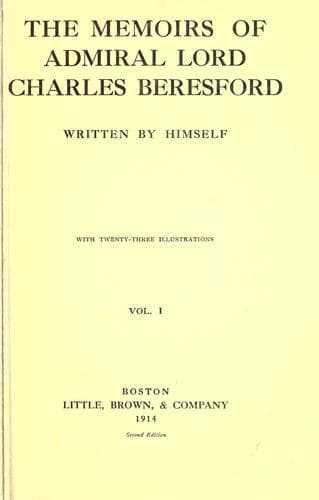
The Memoirs of Admiral Lord BeresfordBeresford, Charles William De la Poer Beresford, Baron
History
The Memoirs of Admiral Lord Beresford
Beresford, Charles William De la Poer Beresford, Baron
Admirals -- Great Britain -- Biography; Great Britain -- History, Naval -- 19th century
At some time between 9 and 10 o'clock Sir Herbert Stewart was hit in
the groin and severely wounded. The knowledge of this disaster was
concealed from the men as long as possible. Then followed a terrible
interval, which lasted for hours. Under that pitiless fire, exposed to
an invisible enemy, men and camels were being hit every minute. All
this time the heat was intense. There we lay in the blazing sun,
helpless, the rattle of rifles all around us, the thin high note of the
bullets singing overheard, or ending with a thud close at hand; men
crying out suddenly, or groaning; camels lying motionless and silent,
blood trickling from their wounds; and no one seemed to know what we
were going to do. Of all things, the most trying to a soldier is to
lie still under fire without being able to reply. It is true that
there was volley firing in reply to the enemy, but they were invisible.
The command had naturally devolved upon Colonel Sir Charles Wilson,
R.E., head of the Intelligence Department. {275} It was clear to me
that unless we marched against the enemy at once, we were done. I
dispatched a written message to Sir Charles Wilson. The messenger was
killed. I sent a second message by Sub-Lieutenant E. L. Munro, R.N.,
who was struck by a bullet which wounded him in seven places.
Shortly afterwards I received a message from Sir Charles Wilson
informing me that he was about to march against the enemy. I was
ordered to remain in command of the zeriba, with Colonel Barrow.
Before forming square, Sir Charles Wilson ordered the breastwork
surrounding the hospital and that defending the little knoll occupied
by the Guards in our rear, to be strengthened into redoubts, in case of
attack. The ammunition boxes must be shifted from the inside of the
main zeriba, and carried across and among the baggage and the packed
and helpless camels, a slow, laborious and dangerous business performed
under fire. Men and officers worked with a will; yet it was 2 o'clock
in the afternoon before they had done. Just then St. Leger Herbert,
private secretary to Sir Herbert Stewart and correspondent of _The
Morning Post_, was shot through the head.
Public-domain text, read in full here on John Shaqi.
Reviews
Reviews
No reviews yet
Be the first to share your thoughts on this work.
Elsewhere in the archive
Join the Discussion
Join the discussion
Sign in to leave a comment or review.
Sign InorCreate an account