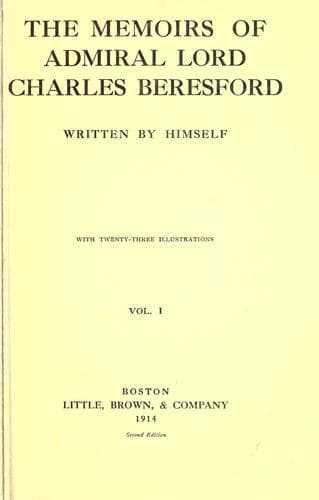
The Memoirs of Admiral Lord BeresfordBeresford, Charles William De la Poer Beresford, Baron
History
The Memoirs of Admiral Lord Beresford
Beresford, Charles William De la Poer Beresford, Baron
Admirals -- Great Britain -- Biography; Great Britain -- History, Naval -- 19th century
The square was composed of half the Heavy Camel Regiment, Guards,
Mounted Infantry, Royal Sussex, Royal Engineers, and some dismounted
Hussars. Sir Charles Wilson placed it under the executive command of
Lieutenant-Colonel the Hon. E. E. Boscawen. The square was formed up
in rear of the zeriba at 2.30 and marched at 3 o'clock. The men were
cool, alert, and perfectly determined. The British soldier had shut
his mouth. He was going to get to the river, enemy or no enemy, or
die. By this time the enemy were plainly visible in full force in
front, horse and foot gathering behind a line of green and white
banners. The moment the square moved beyond the redoubt, it received a
heavy fire. Several men were hit, and were carried back to the zeriba
by our men, while the square moved forward at quick march. It made a
zig-zag course in order to take {276} advantage of the clear patches of
ground among the scrub; lying down and firing, and again advancing.
The Naval Brigade mounted the Gardner gun in the angle of the redoubt,
and, together with the Royal Artillery and two of their screw-guns
under Captain Norton, maintained a steady fire at the three distinct
masses of the enemy. Two of these were hovering in front of the
advancing square, upon the landward slope of the hill rising between us
and the river; the third threatened the zeriba. In all of these we
dropped shells, paying particular attention to the body menacing the
zeriba. When the shells burst in their midst, the dervishes scattered
like a flock of starlings.
In the zeriba were the most of the Hussars, whose horses were worn out,
the Royal Artillery, half the Heavy Camel Regiment, half the Royal
Engineers, what was left of the Naval Brigade, and the wounded in the
hospital. Some 2000 camels were knee-lashed outside and all round the
larger zeriba, forming a valuable breastwork.
All we could do was to work our guns. As the square went on, the
enemy, moving in large masses, shifted their position, and as they
moved, we dropped shells among them. We judged their numbers to be
greater than at Abu Klea. Would the square of only 900 men ever get
through? If ever a little British army looked like walking to certain
death, it was that thin square of infantry.
Presently it disappeared from view. Soon afterwards we heard the
steady roll of volley firing, and we knew that the enemy were charging
the square. Then, silence. Whether the enemy had been driven back, or
the square annihilated, we did not know. What we did know was that if
the square had been defeated, the zeriba would very soon be attacked in
overwhelming force. But as the moments passed the strain of suspense
slackened; for, as the fire of the enemy directed upon the zeriba
diminished and soon ceased altogether, the presumption was that the
square had been victorious and had got through to the river.
Public-domain text, read in full here on John Shaqi.
Reviews
Reviews
No reviews yet
Be the first to share your thoughts on this work.
Elsewhere in the archive
Join the Discussion
Join the discussion
Sign in to leave a comment or review.
Sign InorCreate an account