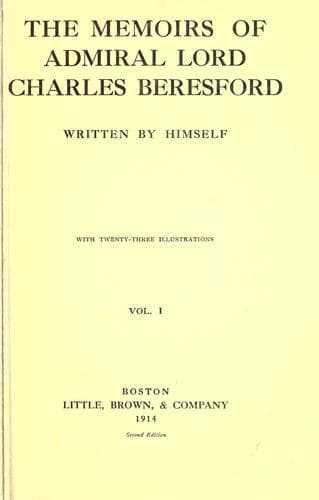
The Memoirs of Admiral Lord BeresfordBeresford, Charles William De la Poer Beresford, Baron
History
The Memoirs of Admiral Lord Beresford
Beresford, Charles William De la Poer Beresford, Baron
Admirals -- Great Britain -- Biography; Great Britain -- History, Naval -- 19th century
The Idlers were not idlers. They were so called because
(theoretically) they had their nights in, although actually they turned
out at four o'clock a.m. They were artificers, such as carpenters,
caulkers, plumbers, blacksmiths, etc. They worked all day at their
several trades until their supper-time. They were nearly all old petty
officers, steady and respectable. It was part of their duty to man the
pumps every morning for washing decks. I made up my mind that, if ever
I was in a position to do so, I would relieve them of an irksome and an
inappropriate duty.
In action, the carpenters worked below decks, stopping holes with
shot-plugs, while many of the other Idlers worked in the magazines.
Among the Idlers was the ship's musician--unless the ship carried a
band--who was a fiddler. He used to play to the men on the forecastle
after working hours and when they manned the capstan. Personally I
always considered the name of Idlers to be anomalous. They are now
called Daymen.
Among the ship's company were several negroes. At that time, it was
often the case that the captain of the hold and the cooper were
coloured men.
An instance of the rapidity and efficiency of the organisation of the
_Marlborough_ occurred upon the night before she sailed for the
Mediterranean. She was newly commissioned, and she carried a large
number of supernumeraries on passage. We took out 1500 all told. A
fire broke out on the orlop deck; the drum beat to quarters; every man
instantly went to his station, to which he had previously been told
off; and the fire was speedily extinguished. The event was my first
experience of discipline in a big ship.
The nature of the discipline which was then in force, I learned on the
way out to the Mediterranean. In the modern sense of the word,
discipline was exemplified by the Royal Marines alone. I cannot better
convey an idea of the old system than by means of an illustration.
Supposing that a Marine and a bluejacket had each committed an offence.
The Marine was brought up on the quarter-deck before the {15}
commander, and the charge was read to him. The commander asked him
what he had to say. The prisoner, standing rigidly to attention,
embarked upon a long rambling explanation. If his defence were
invalid, the commander cut him short, and the sergeant gave his order.
"Right turn. Quick march." The Marine, although continuing to
protest, obeyed automatically, and away he went. He continued to talk
until he was out of hearing, but he went. Not so the bluejacket. He
did not stand to attention, not he. He shifted from one foot to the
other, he hitched his breeches, fiddled with his cap, scratched his
head.
"Well, sir," said he, "it was like this here, sir," ... and he began to
spin an interminable yarn.
"That'll do, my man," quoth the commander. But, not at all. "No, sir,
look here, sir, what I wants to say is this"--and so on, until the
commander had to order a file of Marines to march him below.
Public-domain text, read in full here on John Shaqi.
Reviews
Reviews
No reviews yet
Be the first to share your thoughts on this work.
Join the Discussion
Join the discussion
Sign in to leave a comment or review.
Sign InorCreate an account