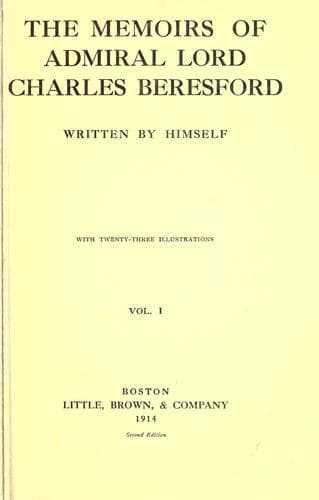
The Memoirs of Admiral Lord BeresfordBeresford, Charles William De la Poer Beresford, Baron
History
The Memoirs of Admiral Lord Beresford
Beresford, Charles William De la Poer Beresford, Baron
Admirals -- Great Britain -- Biography; Great Britain -- History, Naval -- 19th century
I had walked a little way from the redoubt, when I was knocked over by
a stunning blow striking me at the base of the spine, and lay helpless.
I thought I was done; and I thought what an unlucky dog I was to have
come through so much, to die on the way back from a wound in a place so
undignified. But it was only a ricochet; my men carried me in; and I
speedily recovered.
During the day Major F. M. Wardrop, D.A.A.G., and Lieutenant R. J.
Tudway of the Mounted Infantry, with three men, employed the tactics I
had used outside Alexandria two years previously. Riding swiftly from
one point to another, and concealing themselves in the intervals, they
impressed the Dervishes with the delusion that a large force threatened
them in rear, and so caused them to retreat. In the afternoon,
Lieutenant-Colonel H. McCalmont arrived with the news of the action of
the River Column at Kirbekan {326} on the 10th, and of the death of
General Earle. The mail from Korti contained a kind message of
congratulation addressed by the Khedive to myself, referring to the
engagement at Wad Habeshi, as well as congratulations from home. The
total number of killed and wounded during the 16th and 17th was three
men killed, and four officers and 23 men wounded. We heard on the 21st
of the death of our beloved General, Sir Herbert Stewart, who, in spite
of all our hopes, had succumbed to his wound on the 17th, during the
march of Colonel Talbot's convoy, seven miles north of Geb-el-Nus. He
was buried with full military honours on the following day near the
wells of Jakdul.
On the 22nd February a convoy under Colonel Brabazon arrived with 782
camels. These were only just sufficient to move the stores and
supplies.
It may here be noted that it was only a day or two previously that Lord
Wolseley had received at Korti Sir Redvers Buller's letters describing
the complete collapse of the transport of the Desert Column; and it was
this information, together with a minute from Sir Evelyn Wood, who was
at Jakdul, that finally decided Lord Wolseley to abandon his intention
of combining the Desert and River Columns to hold posts along the Nile
preparatory to an autumn campaign. At the same time, great anxiety
with regard to the Desert Column prevailed at home.
Upon the morning of the next day (the 23rd) our picquets reported that
the enemy had received a reinforcement of some 8000 men and six guns.
Perhaps the Column had never been in more imminent danger than it was
at that moment.
Sir Redvers Buller discussed the situation with me. I expressed the
opinion that the large force of the enemy would cut off our advance,
rush us, and then move upon Jakdul and so on to Korti itself; and
remarked that the Column was short of transport and of provisions, and
would be short of water.
{327}
"What would you do if you were in command?" said Buller.
Public-domain text, read in full here on John Shaqi.
Reviews
Reviews
No reviews yet
Be the first to share your thoughts on this work.
Elsewhere in the archive
Join the Discussion
Join the discussion
Sign in to leave a comment or review.
Sign InorCreate an account