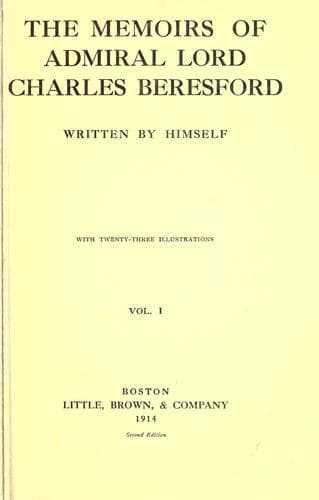
The Memoirs of Admiral Lord BeresfordBeresford, Charles William De la Poer Beresford, Baron
History
The Memoirs of Admiral Lord Beresford
Beresford, Charles William De la Poer Beresford, Baron
Admirals -- Great Britain -- Biography; Great Britain -- History, Naval -- 19th century
I told him that in the evening I would light a larger number of
camp-fires than usual, and, leaving them burning in order to deceive
the enemy, I would then depart in silence and with speed.
"For a sailor ashore," said Buller, "you've a good head. I'll do it."
And he did.
At two o'clock the same afternoon, Sir Redvers Buller sent on his sick
and wounded--32 of all ranks--with a convoy of 300 men commanded by
Colonel Stanley Clarke; and that night, at 7.30, the rest of the Column
stole forth into the desert, leaving a ring of camp-fires flaming in
the dark behind us. We halted after four hours' march and bivouacked
in peace. Next day (the 24th) we were sniped by a few wandering
scouts: and save for these, saw no enemy. Then began the three days'
hard marching, on short rations, and very little water, in great heat,
to Jakdul. Many of the men fell out: but not one man of the Naval
Brigade.
We arrived at Jakdul on the 26th February. I did not keep a diary: but
Lieutenant Colin Keppel's journal defines the situation in three
eloquent words: "Water, mails, cigarettes!"
Next day I found time to write home, the first opportunity for so doing
during the past six weeks.
"Even now (I wrote), I am writing in a storm of sand and wind, my paper
blowing one way and my helmet another, among my camels, who smell most
poisonous. Poor things, they were eight days without water, and had
only what food they could get when foraging in the desert. And they
have so many and so large holes in their backs, that I am obliged to
put shot-plugs in, to keep the water in when they drink...."
It was true that I put shot-plugs in the camels. My official report
(and what can be truer than an official report?) {328} contains under
date 27th February the sole entry: "Employed repairing camels' sides by
plugging them with oakum!" Lord Wolseley laughed when he read it. But
although the surgery may appear empirical, it was wonderfully
successful. The admixture of tar acted as an antiseptic.
On the following day (28th February) we resumed the march to Korti; on
2nd March the Naval Brigade joined Colonel Talbot's convoy at Megaga
Wells, with the Heavy Camel Regiment and Royal Artillery. The Guards'
Camel Regiment had gone on to Abu Halfa. The remainder of the Column
under Sir Evelyn Wood left Jakdul on 3rd March.
At Megaga Wells Colonel Talbot took command and we left for Korti,
officers and men continuing to march on foot, very few having soles to
their boots. There was one camel allocated to carry the kits of five
men; 30 camels carried water; and 10 carried the sick. The thermometer
registered 112° in the shade, and a hot wind blew. And so we came to
Korti on the 8th March, two months after we had left it.
Public-domain text, read in full here on John Shaqi.
Reviews
Reviews
No reviews yet
Be the first to share your thoughts on this work.
Elsewhere in the archive
Join the Discussion
Join the discussion
Sign in to leave a comment or review.
Sign InorCreate an account