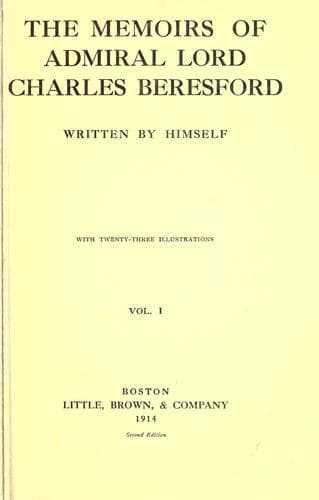
The Memoirs of Admiral Lord BeresfordBeresford, Charles William De la Poer Beresford, Baron
History
The Memoirs of Admiral Lord Beresford
Beresford, Charles William De la Poer Beresford, Baron
Admirals -- Great Britain -- Biography; Great Britain -- History, Naval -- 19th century
"Now I wish to take, most respectfully, issue with the {330} right
honourable the Member for Montrose upon this point. I say this with
great respect and with great earnestness that so far as I can judge
from the right honourable gentleman's writings and by his teachings, he
is no judge of religious fanaticism whatever. I say this with respect
because, as I understand what he has written, he does not regard
religious fanaticism as anything that can ever be powerful, because he
says himself that he does not understand the question at all. That
being so, I cannot accept the right honourable gentleman as a guide as
to what should be done to check religious fanaticism.... The right
honourable the Member for Montrose does not believe in the power of
religious fanaticism...."
Mr. Morley: "The Noble Lord cannot have read my writings, or else he
would have seen that fanaticism was one of the things I have written
most about" (Hansard 5th June, 1899).
A member said to me in the lobby afterwards: "You really ought not to
say these things. Why do you make these assertions?"
"Because," I said, "I have read Mr. Morley's works."
"You know very well," said my friend, "that you have never read any of
his books."
"I beg your pardon," I replied. "I never go to sleep without reading
one of Mr. Morley's books, and I never read one of Mr. Morley's books
without going to sleep."
{331}
CHAPTER XXXIV
THE SOUDAN WAR (_Continued_)
XII. SEQUEL AND CONCLUSION
For the first few weeks after the return of the Desert Column to Korti,
we all believed that there would be an autumn campaign, and we looked
forward to the taking of Khartoum. Lord Wolseley distributed his
troops among various stations along the Nile from the Hannek Cataract
to Abu Dom, there to remain in summer quarters. In his dispatch of 6th
March, 1885 (Colville's _History of the Soudan Campaign_, Part II.),
Lord Wolseley indicated the force he would require, and requested that
the railway might be continued from Halfa to Ferkeh, a distance of 47
miles. The railway was begun and was eventually completed. By 1st
April the troops were occupying their allotted stations. One
distinguished officer was so certain of remaining in his quarters, that
he sowed vegetables in his garden. But upon 13th April Lord Wolseley
was ordered to consider the measures requisite to effect a total
withdrawal; and British faith was once more broken by a British
Government.
By that time Lord Wolseley, to whose personal staff I was once more
attached, had been to Dongola and had come to Cairo.
Public-domain text, read in full here on John Shaqi.
Reviews
Reviews
No reviews yet
Be the first to share your thoughts on this work.
Elsewhere in the archive
Join the Discussion
Join the discussion
Sign in to leave a comment or review.
Sign InorCreate an account