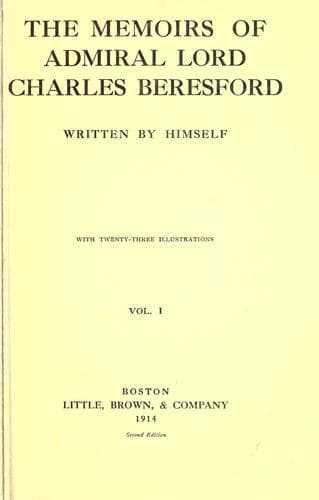
The Memoirs of Admiral Lord BeresfordBeresford, Charles William De la Poer Beresford, Baron
History
The Memoirs of Admiral Lord Beresford
Beresford, Charles William De la Poer Beresford, Baron
Admirals -- Great Britain -- Biography; Great Britain -- History, Naval -- 19th century
The news from home consisted chiefly of rumours of war with Russia; and
I was gratified to learn that largely in consequence of my
representations 50 machine guns had been sent to India. Machine guns
were then upon {332} their trial; and I had been consulted by the
authorities as to their precise utility. We also heard of the hearty
cordiality and enthusiasm with which the Prince and Princess of Wales
were being greeted in Ireland upon the occasion of their visit to my
country. There had been some misgivings upon the subject; and I had
had the honour to suggest to the Prince that if, as well as visiting
towns and cities in state, he went into the country among my people and
shot with them and hunted with them like the sportsman he was, he would
find no more loyal or delightful people in the Queen's dominions.
As a matter of fact, neither in the towns nor anywhere else in Ireland,
did the Prince and Princess receive aught but a most hearty welcome.
Nor did the Nationalist party even attempt to arouse a formal
demonstration directed against their visitors. They might have
suggested, but did not, that some such conventional protest was due to
the doctrine representing Ireland as a conquered country.
At the end of April Lord Wolseley and his staff including myself,
embarked in the s.s. _Queen_ for Souakim.
The Souakim expedition under the command of General Sir G. Graham was
then in full progress. On the 20th February he had been directed to
destroy the power of Osman Digna, and to guard the construction of the
Souakim-Berber railway. On the 20th March, Graham fought the
successful action of Hashin. On the 22nd was fought the bloody
engagement of McNeill's zeriba. The British were surprised while at
work upon the construction of the zeriba; the first shot was fired at
2.50 p.m., and the cease fire was sounded at 3.10. During that twenty
minutes of confused and desperate fighting, some 1500 Arabs out of an
attacking force of 5000 were killed. Desultory firing continued for an
hour, when the enemy retreated. According to the official history, the
British losses were 150 killed, 148 missing, 174 wounded, and 501
camels killed and missing.
The field of battle lay some six miles from Souakim; I {333} rode out
with Lord Wolseley to see it. Before we had ridden three miles in the
dust and the glare of sunlight, the hot air carried a dreadful waft of
corruption. The stench thickened as we drew near. A dusky cloud of
kites and vultures hovered sluggishly and unafraid among a wilderness
of discoloured mounds. The sand was heaped so scantily upon the dead,
that lipless skulls, and mutilated shanks, and clenched hands, were
dreadfully displayed. The bodies of the camels were mingled in a pile
of corruption, clustered upon by the birds of prey.
Public-domain text, read in full here on John Shaqi.
Reviews
Reviews
No reviews yet
Be the first to share your thoughts on this work.
Elsewhere in the archive
Join the Discussion
Join the discussion
Sign in to leave a comment or review.
Sign InorCreate an account