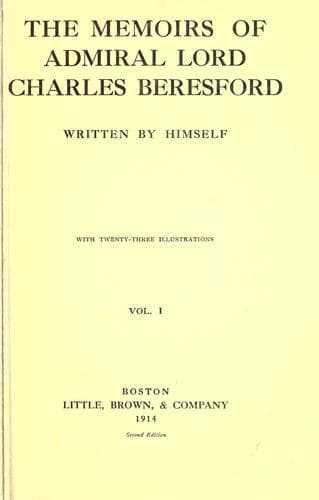
The Memoirs of Admiral Lord BeresfordBeresford, Charles William De la Poer Beresford, Baron
History
The Memoirs of Admiral Lord Beresford
Beresford, Charles William De la Poer Beresford, Baron
Admirals -- Great Britain -- Biography; Great Britain -- History, Naval -- 19th century
And wandering about that charnel-ground, raking in it with a hooked
stick, was a strange man whom I had met years ago in Japan, where he
used to photograph the cruel executions of that country. He spoke no
known tongue, but chattered in a jumble of languages; and here he was,
equipped with a camera, and placidly exploring horrors with a hooked
stick. Whence he came, and whither he went, we stayed not to inquire.
Day after day, for many days, the convoys of the expedition must pass
and repass this place, which lay in their direct route, at the slow
march of laden camels, and walking warily, lest they stepped ankle-deep
into a festering corpse.
General Graham, having occupied Tamai, Handub, and Tambuk, dispersed
the force of Mohammed Sardun on the 6th May; an operation which left
him practically master of the district. But on the 11th May, Lord
Wolseley, acting upon the instructions of the Government, ordered the
general withdrawal of all troops from the Soudan. On the 19th, we left
Souakim for Cairo. On the 27th June, Lord Wolseley turned over the
command of the forces in Egypt to General Sir F. Stephenson, and with
his staff left Cairo for Alexandria, there to embark for England.
Seven days previously (on 20th June), though we knew not of it, the
Mahdi, who had given us so much trouble, had died in Khartoum. There
he lay, listening perhaps for the footsteps of the returning English;
for he knew that, although the English are ruled by people having the
appearance of {334} men but the ways of a weathercock, they may go, but
they always come back. Thirteen years the false prophet slept in
peace: and then the man who had sojourned in a cave at the wells of Abu
Klea secretly collecting information, what time the Desert Column
followed a forlorn hope, rode into the Dervish city, and destiny was
fulfilled. Lord Kitchener of Khartoum fulfilled it, as strong men have
a way of doing. A poet once said that the soul of Gladstone is now
probably perching on the telegraph wires that bridge the desert where
we fought to save Gordon, too late. I know nothing about that; but I
know what the betrayal cost.
We learned afterwards that ere the Mahdi died, he had begun to
concentrate his armies upon Dongola, a movement that was continued
after his death, until the Dervishes were finally defeated by General
Stephenson, at Ginnis, on 30th December, 1885.
General Dormer had a way of his own with the Mahdi's disciples.
Addressing a prisoner, he said:
"I suppose you believe in the Mahdi because he can work miracles. Can
your prophet pluck out his eye and put it back again? Well, I am no
prophet, but I can."
And with that, Dormer took his glass eye from its socket, tossed it in
the air, caught it, and replaced it. The Arab was dumbfounded.
{335}
CHAPTER XXXV
ORGANISATION FOR WAR
Public-domain text, read in full here on John Shaqi.
Reviews
Reviews
No reviews yet
Be the first to share your thoughts on this work.
Elsewhere in the archive
Join the Discussion
Join the discussion
Sign in to leave a comment or review.
Sign InorCreate an account