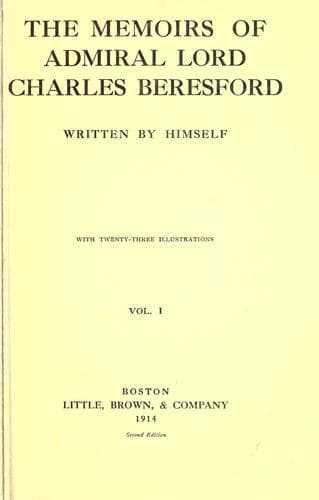
The Memoirs of Admiral Lord BeresfordBeresford, Charles William De la Poer Beresford, Baron
History
The Memoirs of Admiral Lord Beresford
Beresford, Charles William De la Poer Beresford, Baron
Admirals -- Great Britain -- Biography; Great Britain -- History, Naval -- 19th century
Lord Folkestone was standing for Enfield; and when I went down to speak
for him, I found bread upon the waters which returned to me after many
days, in the shape and size of a Royal Marine. While I was speaking,
there arose a tumult at the back of the hall. So far as I could make
out from the platform, a man was insisting on being heard. I called to
him to come up to the platform, where, if he had anything to say, he
could say it. Whereupon a large, resolute and aggressive person came
swiftly up to me. I thought he wanted to fight, and was ready for him.
But he seized my hands in his, shook them warmly, then turned to the
audience and told them the whole story of how I had saved his life off
the Falkland Islands, years before, when I was a lieutenant in the
_Galatea_. The ship was lying at anchor; it was a dark night; when the
Marine somehow fell overboard I had just come on board from a shooting
expedition, and my pockets were full of cartridges. I dived after the
man and seized him. Catching the end of a coil of rope I went down and
down, wondering if the other end of the rope I held was fast, until at
last I felt myself and the Marine being pulled upwards. As we came to
the surface the ship's corporal, who had jumped overboard, got hold of
us, and we were hauled in-board by the quartermaster.
The story was received with great enthusiasm, and I cannot but suppose
it contributed to win the election for my friend, none the less because
there was no real connection whatever between its subject and politics.
Upon my return from Egypt in 1885, I was convinced of the superiority
in guns and armour and general excellence of the French ships of war
over our own, because I had utilised many opportunities of comparing
the vessels of {338} the two navies. Observation and reasoning had
also taught me that in many most essential respects the British Navy
was deficient. And above all, it was deficient in organisation for
war. In these opinions I was confirmed by a large number of my brother
officers, among whom I may mention Lord Alcester, Admiral of the Fleet
Sir Henry Keppel, Admiral Sir Thomas M. C. Symonds, Admiral Sir
Geoffrey T. Phipps Hornby, Captain E. R. Fremantle, Admiral Sir Charles
G. J. B. Elliot, Vice-Admiral Sir William Montagu Dowell, Vice-Admiral
Sir R. Vesey Hamilton.
Accordingly, I enforced the necessity of reform in these matters in my
public speeches, which were numerous. At that time, in the summer of
1885, I find that I was demanding a loan of twenty millions to be
expended upon a shipbuilding programme.
Public-domain text, read in full here on John Shaqi.
Reviews
Reviews
No reviews yet
Be the first to share your thoughts on this work.
Elsewhere in the archive
Join the Discussion
Join the discussion
Sign in to leave a comment or review.
Sign InorCreate an account