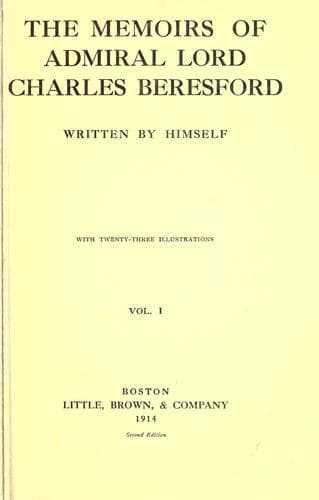
The Memoirs of Admiral Lord BeresfordBeresford, Charles William De la Poer Beresford, Baron
History
The Memoirs of Admiral Lord Beresford
Beresford, Charles William De la Poer Beresford, Baron
Admirals -- Great Britain -- Biography; Great Britain -- History, Naval -- 19th century
During the previous year, 1884, there had appeared in the _Pall Mall
Gazette_, then edited by the late Mr. W. T. Stead, the famous series of
articles over the signature of "One who knows the Facts," dealing with
the state of the Navy, which did more than any other Press
representations before or since to awaken public opinion to the true
condition of our defences. It was those articles, together with
articles in _The Times_ and other newspapers, and the excellent letters
of naval officers--notably those of Admiral of the Fleet Sir T.
Symonds--which prepared the way for me.
International relations with both France and Russia were uneasy; and
war was always a possibility. I knew that we were unprepared for war.
I knew that so long as there was no department charged with the duty of
representing what was required, why it was required, and how much it
would cost, that we should continue to be unprepared for war. I
believed it to be my duty to awaken public opinion to the danger in
which the country undoubtedly stood.
Nor was I alone in this respect. Not only a number of brother
officers, but many students of the subject, did {339} their best to
enlighten the nation. We were of course told that we were creating a
scare; but a study of the Press of those days shows that nearly every
great newspaper, irrespective of its politics, demanded the
strengthening and reorganisation of our defences. Personally, I
received great support from the Press. Writers on the subject of
national defence were at least sure that I had, personally, nothing to
gain by publishing the truth.
Indeed, I had thus early in my career, when I was a junior captain, to
choose between the stormy enterprise of the reformer, and the safer
course of official acquiescence and party obedience, leading to
promotion and to office. In making the choice, I had to consider that
as a naval officer advocating this and that in spite of the
authorities, I laid myself open to the charge that such matters were
none of my business, which was to obey orders. The argument is quite
legitimate. On the other hand, knowing the facts of the case, clearly
perceiving the danger, and (as I believed) knowing also how to remedy
what was wrong, I might (and did) justly contend that my duty to
Sovereign and country came before all. I admit that these things were
not necessarily my business; not, at least, until I made them my
business. But I may also remark that the deplorable condition of the
national defences in 1885 was the result of the united negligence of
the people whose business it was to maintain them, and who had no
department which could supply them with the necessary information; and
that, in consequence, someone had to do something. The history of
England was made by persons who did what it was not their business to
do, until they made it their business.
Public-domain text, read in full here on John Shaqi.
Reviews
Reviews
No reviews yet
Be the first to share your thoughts on this work.
Elsewhere in the archive
Join the Discussion
Join the discussion
Sign in to leave a comment or review.
Sign InorCreate an account