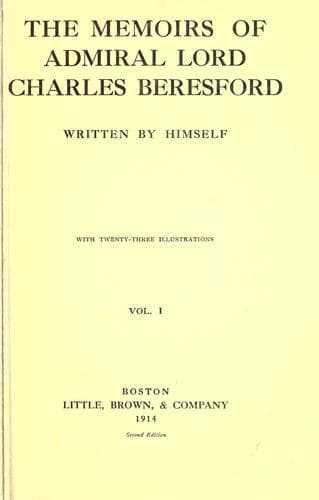
The Memoirs of Admiral Lord BeresfordBeresford, Charles William De la Poer Beresford, Baron
History
The Memoirs of Admiral Lord Beresford
Beresford, Charles William De la Poer Beresford, Baron
Admirals -- Great Britain -- Biography; Great Britain -- History, Naval -- 19th century
will perceive that it is more to their own profit to grant than to
withhold it. And in justice to the politicians, it should be added
that under the existing system, many concessions must be made by the
most austere statesman, if the Duke of Wellington's ultimate principle
is to be observed; the principle that the King's Government must be
carried on.
In July, 1884, Lord Northbrook, the First Lord of the Admiralty in Mr.
Gladstone's administration, publicly declared that if he had £3,000,000
to spend upon the Navy, that force was so sufficient and so efficient
that he would not know on what to spend the money. Before the end of
the year he was compelled to find out how to spend £5,500,000, and to
spend them. From a Liberal Government the Salisbury Government of 1886
inherited the completing of the Northbrook shipbuilding programme;
whose provisions were based, not upon any intelligible scheme of
preparation for war but, upon the Russian war-scare. Those who were
acquainted with the real posture of affairs were not deluded by the
mere haphazard expenditure of a few millions, voted in order to soothe
public opinion.
Nor did ministers themselves deny the total inadequacy of their
measures. In March, 1886, when the Liberal administration was still in
power, I brought forward in the House of Commons an amendment
empowering the Government to expend an additional sum of over
£5,000,000 upon the construction of 35 cruisers, three armoured
cruisers, and 21 torpedo craft; pointing out at the same time that the
expenditure would provide employment for a large number of unemployed
workmen, both skilled and unskilled. Of course the amendment was
defeated; but it is significant that {342} the necessity of such an
increase was virtually admitted by the Government spokesmen. I also
urged the abolition of 69 useless vessels of war, which I specified,
and the expenditure of the money saved in their maintenance, upon new
vessels.
At that time, it was nearly impossible to obtain accurate official
information with regard to naval affairs. I asked for a return of the
relative strength of the Fleets of this and other countries; which was
granted; and which aroused considerable comment in the Press. The
return has since been issued every year; first in my name, then in the
name of Sir Charles Dilke, and at present in the name of Mr. Dickenson.
But the first half of the year 1886 was consumed with the Home Rule
Bill. Turn to the files of the time, and you shall see precisely the
same arguments, declarations, denunciations, intrigues and rumours of
intrigues, charges and counter-charges which were repeated in 1893, and
which are being reiterated all over again as if they had just been
discovered, in this year of grace 1913. We who stood to our guns in
1886 know them by heart. We have been denounced as traitors and rebels
because we stand by Ulster, for so long, that we are beginning to think
we shall escape hanging at the latter end of it.
Public-domain text, read in full here on John Shaqi.
Reviews
Reviews
No reviews yet
Be the first to share your thoughts on this work.
Elsewhere in the archive
Join the Discussion
Join the discussion
Sign in to leave a comment or review.
Sign InorCreate an account