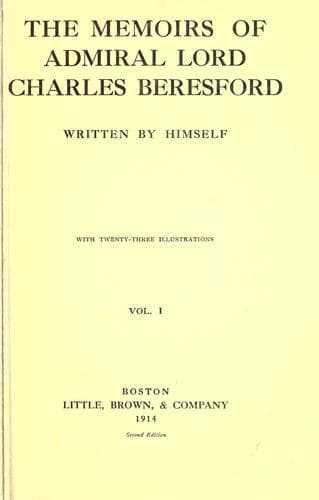
The Memoirs of Admiral Lord BeresfordBeresford, Charles William De la Poer Beresford, Baron
History
The Memoirs of Admiral Lord Beresford
Beresford, Charles William De la Poer Beresford, Baron
Admirals -- Great Britain -- Biography; Great Britain -- History, Naval -- 19th century
My difficulties were then, and have always been, inherent in the nature
of the case. It is part of the character of the English people to
trust in authority, as such; and they are quite right in principle;
whose observance, however, induces them to be slow to act when
authority has proved untrustworthy. Again, in order that my case
should be proved beyond cavil, the supreme demonstration of war was
required. It is not {340} enough that because my recommendations were
carried into execution, war was prevented; for only the few who know
the facts and who are acquainted with the complex shifts of
international policy, understand the value of potential armed force in
the exercise of diplomacy. I may claim, indeed, I do claim, that
sooner or later my recommendations have been adopted by the
authorities, who thereby proved the justice of my case. Nor do I
complain because they have gained the credit accruing to their action;
for it must always be the man who does the thing who earns the laurel.
And he who insists upon assuming the office of reformer, must make up
his mind at the beginning to renounce without bitterness whatever
delight he might discover in reward or fame or renown. Moreover, the
credit belongs to no one man, but to the many fearless officers who
urged reform, and not less to the great body of those officers of the
Service who silently and loyally kept the routine going, and without
whom no reforms could avail.
The whole position is of course quite illogical; as illogical as that
venerable anomaly, the British Constitution, which exists entirely in
the brains of the learned. A certain set of persons are selected to
govern the nation by a majority of votes, those votes being allocated
upon an accidental system which gives to a small number exactly the
same representation as an immensely larger number. Out of that set a
few are selected to form a governing committee called the Cabinet,
which is virtually omnipotent so long as it continues to act more or
less in accordance with the wishes of the majority which elected it.
The Cabinet is, therefore, in practice, constrained to act in
accordance with the known opinions of its supporters; a course of
action which is a totally different thing from the course which it is
theoretically supposed to follow. Theoretically, the Cabinet shapes
its policy to ensure the welfare of the whole nation. Theoretically,
the business of the Government is to govern. Theoretically, its
members are the men in the country best fitted for the work. Sometimes
they are; and in proportion as they are, they will {341} approximate to
the conventional theory and will depart from the common practice, and
will do what is right instead of what is expedient. Thus every
Government oscillates between pure opportunism and honest patriotism.
And in the result, the only method of obtaining reform in any direction
is so to persuade the public of its necessity, that the party in power
Public-domain text, read in full here on John Shaqi.
Reviews
Reviews
No reviews yet
Be the first to share your thoughts on this work.
Elsewhere in the archive
Join the Discussion
Join the discussion
Sign in to leave a comment or review.
Sign InorCreate an account