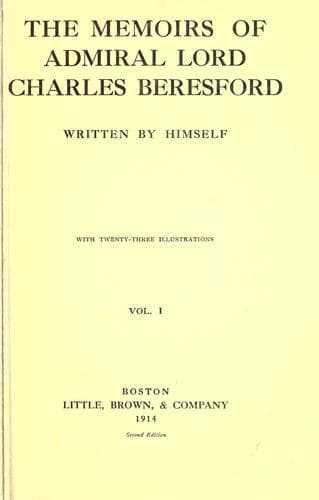
The Memoirs of Admiral Lord BeresfordBeresford, Charles William De la Poer Beresford, Baron
History
The Memoirs of Admiral Lord Beresford
Beresford, Charles William De la Poer Beresford, Baron
Admirals -- Great Britain -- Biography; Great Britain -- History, Naval -- 19th century
Mr. Gladstone's Home Rule Bill having been rejected in 1886, Lord
Salisbury returned to power with a majority that defied Mr. Parnell and
his friends, and so there was no {344} more Home Rule for a while.
'Tis the pure morality of the Home Rule demand that moves the political
conscience; and that the morality always acts upon that sensitive organ
when there is a controlling Irish vote, and not at any other time, is
of course a mere coincidence.
In August, 1886, I was appointed junior lord at the Admiralty,
succeeding Captain James E. Erskine.
"No doubt you'll try to do a number of things, but you'll run up
against a dead wall. Your sole business will be to sign papers," said
Captain Erskine, and so departed.
I speedily discovered that there was at the Admiralty no such thing as
organisation for war. It was not in the distribution of business.
Lest I should seem to exaggerate, I quote the testimony of the late Sir
John Briggs, Reader to the Lords and Chief Clerk of the Admiralty.
Referring to the period with which I am dealing, Sir John Briggs writes
as follows (_Naval Administrations, 1827 to 1892_. Sampson Low. 1897):
"During my Admiralty experience of forty-four years, I may safely
affirm that no measures were devised, nor no practical arrangements
thought out, to meet the numerous duties which devolve upon the
Admiralty, and which at once present themselves at the very beginning
of a war with a first-class naval Power; on the contrary, there had
been unqualified apprehension on the mere rumour of war, especially
among the naval members, arising from their consciousness of the
inadequacy of the Fleet to meet the various duties it would be required
to discharge in such an eventuality."
The fact was that after Trafalgar this country had attained to so
supreme a dominance upon all seas, with so high a degree of
sea-training acquired in independent commands, that organisation for
war was taken for granted. We were living on the Nelson tradition.
The change came with the advent of steam, which altered certain
essential conditions of sea warfare. The use of steam involved a new
organisation. Other nations recognised its necessity. We {345} did
not. Nor was it that the distinguished naval officers composing
successive Boards of Admiralty neglected their duty, for organisation
for war did not form part of their duty, as they conceived it.
Moreover, they were wholly occupied with the vast labour of routine
business, which developed upon them when the old Navy Board was
abolished. The Navy Board, in the old wars, was charged with the
provision of all matters of supply, leaving the Lords Commissioners
free to conduct war.
Public-domain text, read in full here on John Shaqi.
Reviews
Reviews
No reviews yet
Be the first to share your thoughts on this work.
Elsewhere in the archive
Join the Discussion
Join the discussion
Sign in to leave a comment or review.
Sign InorCreate an account