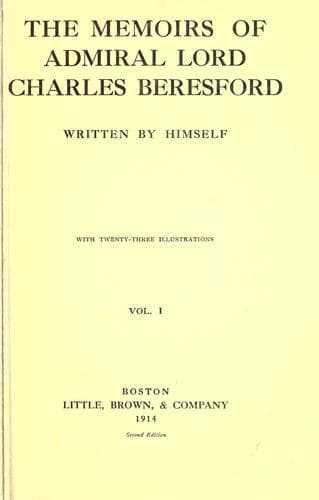
The Memoirs of Admiral Lord BeresfordBeresford, Charles William De la Poer Beresford, Baron
History
The Memoirs of Admiral Lord Beresford
Beresford, Charles William De la Poer Beresford, Baron
Admirals -- Great Britain -- Biography; Great Britain -- History, Naval -- 19th century
That there existed no department charged with the duty of constantly
representing what was required in ships, men, stores, docks, under
peace conditions, or what would be required under war conditions, was
obvious enough. But in the course of the execution of my duties as
junior lord, it immediately became equally clear that the Navy was
deficient in those very matters and things concerning which it would
have been the business of such a department to report. Among them was
coal, which was in my charge. Not only was there an immense deficiency
in the war reserve of coal, but there was no plan for supplying it.
What my friends used to call my "craze," which they regarded as an
amiable form of lunacy, for organisation for war, showed me that
without it, all naval force, though it were twice as powerful, would be
practically wasted in the event of emergency.
I went to the First Lord and asked him if it would be in order for me
to draw up a memorandum on any subject to be laid before the Board.
Lord George Hamilton, with his invariable courtesy, replied that any
such paper would be gladly considered.
Within six weeks of my appointment to the Admiralty, I had drawn my
Memorandum on War Organisation calling attention to the necessity of
creating a Naval Intelligence Department at the Admiralty.
In that document, it was represented:
1. That although recent events had revealed approximately our
deficiencies in the event of war with a {346} second-rate maritime
Power, no measures had been taken to prepare a plan showing how the
requirements were to be met.
2. That other countries possessed departments charged with the duty of
preparing plans of campaign and of organising their every detail so
that they could be instantly carried into execution.
3. That the deficiencies in the numbers of the personnel known to be
required, were such and such.
4. That the Medical stores were deficient in such and such respects.
(They were kept in bulk, so that in the event of war, the medical
stores would have had to be selected and distributed: a system I was
able to alter.)
5. That there existed no organisation of any kind with regard to the
use of merchant shipping in war for the transport of coal, ammunition,
and stores, and for hospital ships.
6. That there existed no organisation for rapidly mobilising the
reserves.
7. That in order rightly to fulfil these requirements, there must be
designed plans of campaign to meet all probable contingencies.
8. That in order to obtain such plans of campaign, there should be
created a new department charged with the duty of drawing them up.
There followed a detailed scheme for a new Intelligence Department, at
an increased expense of no more than £2251.
The Memorandum concluded as follows:
"1. Can it be denied that the gravest and most certain danger exists to
the country if the facts stated in this paper are true?
"2. Can it be denied that these facts are true?
Public-domain text, read in full here on John Shaqi.
Reviews
Reviews
No reviews yet
Be the first to share your thoughts on this work.
Elsewhere in the archive
Join the Discussion
Join the discussion
Sign in to leave a comment or review.
Sign InorCreate an account