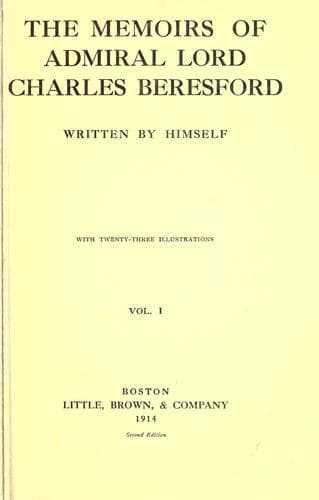
The Memoirs of Admiral Lord BeresfordBeresford, Charles William De la Poer Beresford, Baron
History
The Memoirs of Admiral Lord Beresford
Beresford, Charles William De la Poer Beresford, Baron
Admirals -- Great Britain -- Biography; Great Britain -- History, Naval -- 19th century
During the same month, Mr. William White, Chief Constructor to the
Admiralty, read a paper at the Mansion House dealing with the design of
modern men-of-war, which marked an era in shipbuilding. Sir William
White restored to the ship of war that symmetry and beauty of design
which {351} had been lost during the transition from sails to steam.
The transition vessels were nightmares. Sir William White designed
ships. A man of genius, of a refined and beautiful nature, a loyal
servant of the Admiralty, to which he devoted talents which, applied
outside the Service, would have gained him wealth, his recent death was
a great loss to his country. The later Victorian Navy is his splendid
monument: and it may yet be that history will designate those noble
ships as the finest type of steam vessels of war.
About the same time, I brought forward another motion in the House of
Commons, to abolish obsolete vessels, of which I specified fifty-nine,
and to utilise the money saved in their maintenance, in new
construction. The scheme was carried into execution by degrees.
In June of 1887, I invited a large party of members of the House of
Commons to visit Portsmouth, where they were shown something of the
Navy.
In December of the same year, speaking in public, I affirmed the
following principles: that in time of war our frontiers were the ports
of the enemy; that our main fleets could be required to watch those
ports; and that the strength of the Fleet required should be calculated
upon the basis of the work it would be required to perform. I also
urged that the line of communications should be instituted, by means of
establishing a system of signalling between the ships of the Navy and
the ships of the mercantile marine, and between all ships and the
shore. At that time there was no such system.
The Press and the public received the exposition of these elementary
principles of organisation for war as a complete novelty; by many they
were welcomed like a revelation; circumstances which exemplify the
general ignorance prevailing at the time.
Of even more significance were the official declarations on the
subject. The First Lord of the Admiralty, Lord George Hamilton, had
publicly stated in November, 1886, that this country had more ships in
commission than the {352} three other European Naval Powers next in
order of strength. The statement was correct; but among the ships in
commission were included many vessels of no fighting value, such as the
_Indus_, _Asia _and _Duke of Wellington_. As an estimate of
comparative fighting strength, the statement, like many another
official statement before and since, required qualification; as I
remarked in the House of Commons in the course of my reply to Lord
George Hamilton.
Public-domain text, read in full here on John Shaqi.
Reviews
Reviews
No reviews yet
Be the first to share your thoughts on this work.
Elsewhere in the archive
Join the Discussion
Join the discussion
Sign in to leave a comment or review.
Sign InorCreate an account