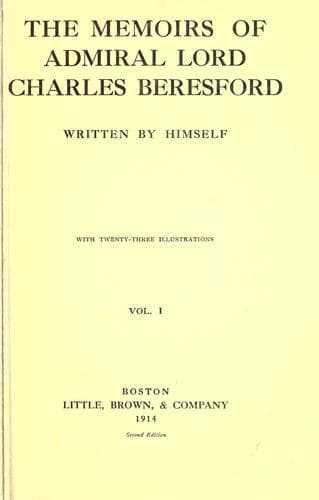
The Memoirs of Admiral Lord BeresfordBeresford, Charles William De la Poer Beresford, Baron
History
The Memoirs of Admiral Lord Beresford
Beresford, Charles William De la Poer Beresford, Baron
Admirals -- Great Britain -- Biography; Great Britain -- History, Naval -- 19th century
In the result, that particular and inestimably important office was
gradually dropped. The department became an Intelligence Department
alone. The First Sea Lord was charged with the duty of preparation and
organisation for war. After various changes in the distribution of
business, it was again discovered that there was no organisation for
war; that the First Sea Lord, though (as I said in 1886) he had a head
as big as a battleship, could not accomplish the work by himself; and a
War Staff, affiliated to the Intelligence Department, was constituted
in 1912.
In other words, twenty-six years elapsed before my scheme was carried
into full execution.
On the 13th October, 1886, the substance of my confidential Memorandum
on Organisation for War was published in the _Pall Mall Gazette_. It
was stolen from the Admiralty by an Admiralty messenger, who was
employed by both the First Sea Lord and myself. The contents of
several other confidential documents having been published, suspicion
fell upon the messenger, and a snare was laid for {349} him. An
electric contact was made with a certain drawer in the desk of the
First Sea Lord, communicating with an alarm in another quarter of the
building. Upon leaving his room, the First Sea Lord told the messenger
to admit no one during his absence, as he had left unlocked a drawer
containing confidential documents. A little after, the alarm rang, and
the messenger was discovered seated at the desk, making a copy of the
documents in question. He was arrested, brought to trial, and
sentenced.
{350}
CHAPTER XXXVI
THE TWENTY-ONE MILLION
In January, 1887, my routine work at the Admiralty was varied by a trip
in the new submarine _Nautilus_ to the bottom of Tilbury Dock, which
was very nearly the last voyage of the party in this world. The owners
of the boat, Mr. Edward Wolseley and Mr. C. E. Lyon, had invited
several guests, among whom was Mr. William White (afterwards Sir
William Henry White, K.C.B., F.R.S., etc.), together with some
officials of the Admiralty. The theory was that by pushing air
cylinders to project from each side of the boat, her buoyancy would be
so increased that she would rise to the surface. We sank gently to the
bottom and stayed there. The cylinders were pushed out, and still we
remained there. I was looking through the glass scuttle, and, although
in a submarine the motion or rising or sinking is not felt by those
within, I knew that we had not moved, because I could see that the
muddy particles suspended in the water remained stationary. The Thames
mud had us fast. In this emergency, I suggested rolling her by moving
the people quickly from side to side. The expedient succeeded, none
too soon; for by the time she came to the surface, the air was very
foul.
Public-domain text, read in full here on John Shaqi.
Reviews
Reviews
No reviews yet
Be the first to share your thoughts on this work.
Elsewhere in the archive
Join the Discussion
Join the discussion
Sign in to leave a comment or review.
Sign InorCreate an account