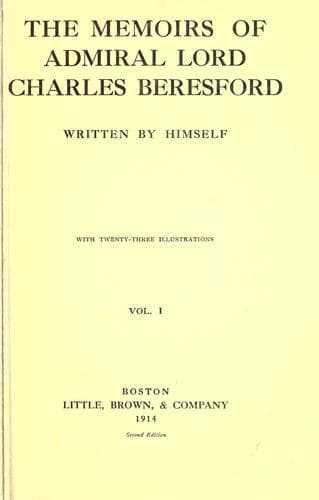
The Memoirs of Admiral Lord BeresfordBeresford, Charles William De la Poer Beresford, Baron
History
The Memoirs of Admiral Lord Beresford
Beresford, Charles William De la Poer Beresford, Baron
Admirals -- Great Britain -- Biography; Great Britain -- History, Naval -- 19th century
We put the fires out, but the inhabitants were so angry with us because
we had not prevented the bombardment, that they requested that the
landing-party should be sent back to their ships. Then the flames
broke out afresh. For years the resentment of the Valparaisians
remained so hot that it was inadvisable to land in the town men from
British ships.
The meeting of the British and American seamen gave rise to much
discussion concerning the respective merits of the British and American
theories of gunnery. The Americans advocated the use of round shot to
deliver a "racking blow"; the British preferred firing a pointed
projectile which would penetrate the target instead of merely striking
it. When an American bluejacket asked his British friend to explain
the new English system of {68} shell-fire, the British bluejacket said:
"We casts our shot for the new gun so many fathoms long, and then, d'ye
see, we cuts off a length at a time, regulatin' the length required
according to the ship we uses it against. For your ship, I reckon we
should cut off about three and a half inches."
The Spanish fleet was afflicted with scurvy; and we used to pull over
to the Spanish ships in the evenings, bringing the officers presents of
chicken, fresh meat and fruit.
Having done with Valparaiso, the Spaniards went to Callao; but there
they had a more difficult job; for Callao was fortified, and the
Spaniards were considerably damaged by the gun-fire from the forts.
During the progress of hostilities between the Chilians and the
Spaniards, the Chilians constructed one of the first submarines. It
was an American invention worked by hand and ballasted with water. The
Chilians intended, or hoped, to sink the Spanish fleet with it. The
submarine started from the beach on this enterprise; but it was never
seen again. It simply plunged into the sea, and in the sea it remains
to this day.
We left Valparaiso about the middle of April, 1866, and proceeded to
Vancouver. On the way, the _Sutlej_ ran into a French barque, taking
her foremast and bowsprit out of her. Captain Coode stood by the rail,
his arms crossed, his hands folded in his sleeves, looking down upon
the wreck with a sardonic grin, while the French captain, gesticulating
below, shouted, "O you goddam Englishman for you it is all-a-right, but
for it it is not so nice!"
But we repaired all damages so that at the latter end he was better off
than when he started.
We arrived at Vancouver early in June, and left a few days later, to
encounter a terrific hurricane. It blew from the 18th June to the 22nd
June; and the track of the ship on the chart during those four days
looks like a diagram of cat's-cradle. The ship was much battered, and
her boats were lost. On this occasion, I heard the pipe go "Save ship"
for the second time in my life.
{69}
Public-domain text, read in full here on John Shaqi.
Reviews
Reviews
No reviews yet
Be the first to share your thoughts on this work.
Elsewhere in the archive
Join the Discussion
Join the discussion
Sign in to leave a comment or review.
Sign InorCreate an account