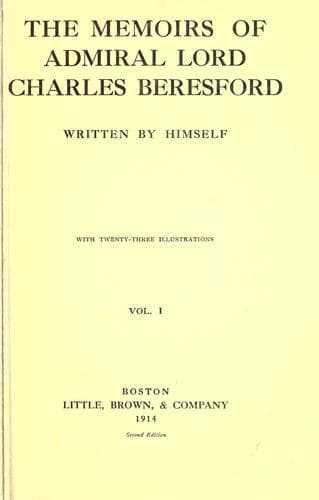
The Memoirs of Admiral Lord BeresfordBeresford, Charles William De la Poer Beresford, Baron
History
The Memoirs of Admiral Lord Beresford
Beresford, Charles William De la Poer Beresford, Baron
Admirals -- Great Britain -- Biography; Great Britain -- History, Naval -- 19th century
We put into San Francisco to refit. Here many of our men deserted. In
those days, it was impossible to prevent desertions on these coasts,
although the sentries on board had their rifles loaded with ball
cartridge. Once the men had landed we could not touch them. I used to
meet the deserters on shore, and they used to chaff me. As we had lost
our boats, the American dockyard supplied us with some. One day the
officer of the watch noticed fourteen men getting into the cutter,
which was lying at the boom. He hailed them from the deck. The men,
returning no answer, promptly pushed off for the shore. The officer of
the watch instantly called away the whaler, the only other boat
available, intending to send a party in pursuit. But the deserters had
foreseen that contingency, and had cut the falls just inside the
lowering cleat, so that the whaler could not be lowered.
While I was at San Francisco, I had my first experience of the American
practical view of a situation. Bound upon a shooting excursion, I had
taken the train to Benicia, and alighted with a small bag, gun and
cartridges. I asked a railway man to carry my bag for me to a hack
(cab). He looked at me, and said,
"Say, is it heavy?"
"No," I said, "it is quite light."
"Waal then," said he, "I guess you can carry it yourself." I had to,
so I did.
Benicia is celebrated as the birthplace of John Heenan, the "Benicia
Boy," the famous American boxer. The great fight between Heenan and
Tom Sayers was fought at Farnborough on the 17th April, 1860. Heenan
was a huge man, six feet and an inch in height; Sayers, Champion of
England, five feet eight inches. The fight was interrupted. Both men
received a silver belt. I remember well the event of the fight, though
I was not present at it. More than three years afterwards, in
December, 1863, Tom King beat Heenan.
From San Francisco we proceeded to Cape Horn, {70} homeward bound. On
these long sailing passages we used to amuse ourselves by spearing
fish. Sitting on the dolphin-striker (the spar below the bowsprit) we
harpooned albacore and bonito and dolphin, which is not the dolphin
proper but the coryphee.
We rounded the Horn, buffeted by the huge seas of that tempestuous
promontory. On that occasion, I actually saw the Horn, which is an
inconspicuous island beaten upon by the great waves, standing amid a
colony of little black islands. And off Buenos Aires we were caught in
a pampero, the hurricane of South American waters. It blew from the
land; and although we were three or four hundred miles out at sea, the
master smelt it coming. Indeed, the whole air was odorous with the
fragrance of new-mown hay; and then, down came the wind.
We were bound for Portsmouth. And when we rounded the Isle of Wight,
and came into view of Spithead, lo! the anchorage was filled with great
ships all stationed in review order. They were assembled for a review
to be held for the Sultan of Turkey.
Public-domain text, read in full here on John Shaqi.
Reviews
Reviews
No reviews yet
Be the first to share your thoughts on this work.
Elsewhere in the archive
Join the Discussion
Join the discussion
Sign in to leave a comment or review.
Sign InorCreate an account