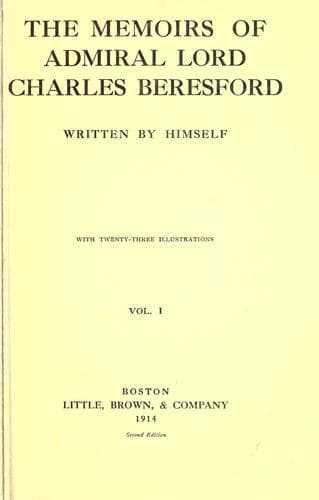
The Memoirs of Admiral Lord BeresfordBeresford, Charles William De la Poer Beresford, Baron
History
The Memoirs of Admiral Lord Beresford
Beresford, Charles William De la Poer Beresford, Baron
Admirals -- Great Britain -- Biography; Great Britain -- History, Naval -- 19th century
The entrance hall of the mansion of Curraghmore is the ancient keep,
which was built by the De la Poers in the late twelfth or early
thirteenth century, foursquare, the walls ten feet thick. The rest of
the house is eighteenth century. The original edifice is briefly
described in _The Antient and Present State of the County and City of
Waterford_, by Charles Smith, published in Dublin in 1740, and in _The
History, Topography and Antiquities of the County and City of
Waterford_, by the Rev. R. H. Ryland, published by Murray in 1824. Sir
Marcus, first Earl of Tyrone, and his son, afterwards first Marquess of
Waterford, made considerable additions, which, according to the date
inscribed upon the lead work, were completed in 1771. From the old
keep, transformed into an eighteenth-century entrance hall, a flight of
steps leads to the inner hall, whence a wide staircase rises, following
the walls, and out of which open the reception rooms. These face upon
lawn and fountain and terrace. Over the entrance door are carved the
family coat; {xxii} and the crest of the De la Poers, a stag couchant
bearing a cross upon his forehead, crowns the parapet. Upon the garden
front are sculptured the Beresford shield and their crest, "a dragon's
head erased, the neck pierced with a tilting spear, and holding the
point broken off in the mouth." Motto, _Nil nisi cruce_.
Such was the home of the five brothers, when their father, Lord John dc
la Poer Beresford, in holy orders, succeeded his brother in 1859. Lord
Charles Beresford, who had been for some years at school in England,
joined the Navy in that year. He came to Curraghmore in his brief and
widely spaced intervals of leave, while his brothers came home more
frequently during their vacations. In those days, the stables were
filled with horses, the house was populous with guests; and the great
courtyard in front of the house, now silent, resounded with the cheery
bustle of a jovial company coming and going. All winter the house was
thronged; there was hunting six days in the week; and more than a
hundred horses were stabled at Curraghmore. Lord Charles Beresford has
told how that many a time, when, as a midshipman, he was humping beef
into the blood-boats for the Fleet, did he think not without envy upon
his brothers, each with his two or three hunters, riding to hounds at
Curraghmore.
The house of Beresford derives from the "very old and eminent English
family of Beresford of Beresford, in the county of Stafford," and from
the De la Poers, an ancient Breton family, and their quarterings
include the noble houses of Hamilton, Monck, Carpenter, Plantagenet,
Lastile and Leon, Mortimer, De Burgh, Holland, Wake, Wevill, Beauchamp,
Delaval, Blake. The Beresfords represented the English plantation in
the North of Ireland, until the marriage was made which united them
with De la Poers, who were of the first English plantation in the South.
Public-domain text, read in full here on John Shaqi.
Reviews
Reviews
No reviews yet
Be the first to share your thoughts on this work.
Join the Discussion
Join the discussion
Sign in to leave a comment or review.
Sign InorCreate an account