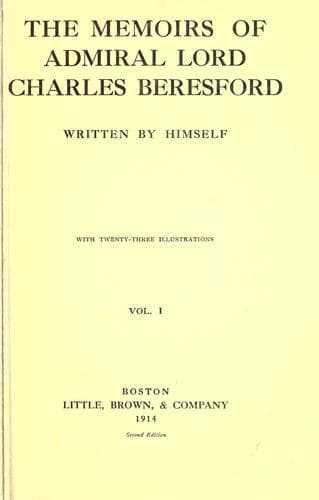
The Memoirs of Admiral Lord BeresfordBeresford, Charles William De la Poer Beresford, Baron
History
The Memoirs of Admiral Lord Beresford
Beresford, Charles William De la Poer Beresford, Baron
Admirals -- Great Britain -- Biography; Great Britain -- History, Naval -- 19th century
In 1861, Mr. Heuskin, attached to the American Legation, was murdered.
Soon afterwards, one of the Governors (or Under-Secretaries) of Foreign
Affairs, {94} Oribeno-no-Kami, who had been especially friendly in his
intercourse with the Legations, "died," in the Japanese phrase,
"without the effects of medicine." To be more precise, he had
committed hara-kiri.
In July, 1861, the British Legation at Yedo was attacked at night by a
band of swordsmen, who passed the guards and rushed the building. Mr.
Oliphant, who had recently been appointed Secretary to the Legation,
was severely wounded. One of the guards, a porter, and a groom, and
two of the assailants, were killed outright. One of the assailants was
severely wounded, to six of the Legation party who were severely
wounded and eleven slightly wounded.
Such were the beginnings of Western influence in Japan. Sir Rutherford
Alcock's voluminous account of his three years' ministry reveals a
gallant, honest, kindly gentleman sorely perplexed by the ethical
problems involved in the forcible interference of one powerful nation
in the affairs of a weaker nation, whose sole ambition was to be let
alone. Hampered, on the one hand, by the greed and discourtesy of the
European traders, and on the other, by the immitigable duplicity and
the furtive and implacable enmity of the Japanese, yet singly
determined to do his duty to his Queen and country, Sir Rutherford
Alcock honourably fulfilled a task of extreme danger and incredible
difficulty.
Thenceforward, until the year 1869, the duel between East and West
continued with increasing ardour. The whole polity of old Japan was
shaken as by the earthquakes which agitate and rend its soil. There
were frequent assassinations of the foreign barbarians; the governing
classes, which consisted wholly of the military caste, employed every
invidious method to restrict trade with Europeans; while the Western
nations, on their side, brought their armed strength to bear in the
enforcement of treaty rights, which by the same means had originally
been wrung from the Tycoon's government. And here it falls to
distinguish between the divine prestige of the Mikado, {95} descendant
of the sun-goddess, and the temporal administration of the Tycoon, or
Shogun. In that dual administration resided a main factor of the
extraordinary difficulty of the situation. Both the spiritual and
temporal rulers, the Imperial Court and the Bakufu, or Tycoon's
Government, were equally inspired by hatred of the foreigner. But
whereas the Mikado, dwelling majestically apart, could avoid all
contact with the barbarians, the Tycoon was compelled by superior force
to negotiate with them. He was thus placed between two fires; on the
one side, the Mikado ordered him to expel the foreigner; on the other,
the foreigner threatened him with war unless the treaties were carried
into execution.
Public-domain text, read in full here on John Shaqi.
Reviews
Reviews
No reviews yet
Be the first to share your thoughts on this work.
Elsewhere in the archive
Join the Discussion
Join the discussion
Sign in to leave a comment or review.
Sign InorCreate an account