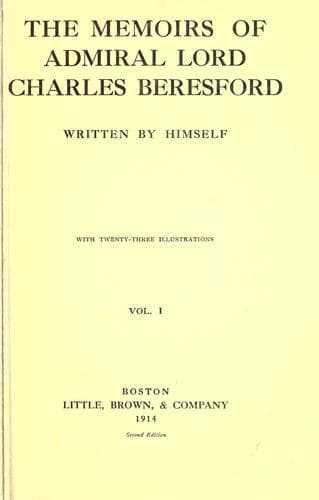
The Memoirs of Admiral Lord BeresfordBeresford, Charles William De la Poer Beresford, Baron
History
The Memoirs of Admiral Lord Beresford
Beresford, Charles William De la Poer Beresford, Baron
Admirals -- Great Britain -- Biography; Great Britain -- History, Naval -- 19th century
For long the Tycoon, or his advisers, maintained his position with
singular address. But no man born of woman could have solved its
complications. For the great Daimios, the feudal nobility, held
allegiance primarily to the Mikado. The Tycoon could and did detach
some of the clans to his side; but the great body of the western clans
defied him. The influence of the Tycoon began swiftly to decline. At
the same time the Imperial party began to perceive that the expulsion
of foreigners had become impossible. The immediate result was the
revolt of some of their adherents. Inspired as it was by hatred of the
foreigner, it was directed equally against Mikado and Tycoon, and
accompanied by expressions of loyalty to both parties.
In 1864 the troops of the Choshiu clan attempted to capture Kioto and
to obtain possession of the person of the Mikado. They were defeated
after heavy fighting. In June of the previous year, the Choshiu men
had fired upon the American ship _Pembroke_ while she was passing
through the Inland Sea, and also upon the Dutch corvette _Medusa_. The
French commander-in-chief of the station, Admiral Jaurès proceeded to
Shimoseki and destroyed the batteries. In August a British naval force
under the command of Vice-Admiral Kuper proceeded to Kagoshima in order
to enforce {96} the payment of the indemnity due for the murder of Mr.
Richardson, bombarded the town and destroyed the batteries. It was
these two actions which for the first time really convinced the ruling
classes in Japan that it was hopeless any longer to endeavour to
prevent the intrusion of foreign influence.
In 1866 the Tycoon Iyemochi died. In the same year a new and enlarged
Convention was concluded with Great Britain, France, America and
Holland. In the following year Keiki, very unwillingly, became Tycoon,
an office which by this time had become exceedingly insecure. In the
same year the Mikado, Komei, died and was succeeded by his son
Mutsuhito, a minor. In the following year the Mikado assumed the whole
administrative power hitherto vested in the Tycoon, and a new system of
Government was promulgated. Followed, civil war and the defeat of the
Tycoon, who retired into seclusion. In the meantime the Mikado had
invited the Representatives of Foreign Powers to visit him at Kioto.
"That the Mikado of Japan, who claims to be descended from the
sun-goddess, and in whose person a peculiar odour of sanctity was
considered to exist, should voluntarily invite to his palace at Kioto
the Envoys of nations who had hitherto been looked upon as outer
barbarians, and intercourse with whom was a profane thing, was indeed a
great step in advance. No foreigner had ever yet crossed the Imperial
threshold, or looked upon the face of the sacred Emperor of Japan. It
was a proof that a new order of things was inaugurated, and gave good
hopes for the future" (Adams, _History of Japan_. Lond., 1875).
Public-domain text, read in full here on John Shaqi.
Reviews
Reviews
No reviews yet
Be the first to share your thoughts on this work.
Elsewhere in the archive
Join the Discussion
Join the discussion
Sign in to leave a comment or review.
Sign InorCreate an account